
If you’re early in OASIS+ planning, the fastest way to waste B&P is to start collecting documents and “self-scoring” before you Choose OASIS+ track. In OASIS+, that lane determines who you compete against and which eligibility rules apply. To ground your team in the official structure, start with GSA’s OASIS+ overview and the OASIS+ contracts page.
For the contractor-friendly Phase II view with practical readiness notes, see GDIC’s OASIS+ Phase II profile.
Quick Orientation
If you’re aligning internal stakeholders, confirm the official track structure first, then use GDIC’s Phase II profile to translate it into a practical action plan.
Choose OASIS+ track in 60 seconds
Use this order of operations to avoid rework:
- Confirm whether you are small for the work you actually plan to pursue
- If you are small, confirm whether you are currently SBA-certified for a socioeconomic program
- Then pick domains, build your evidence plan, and decide whether teaming is required
If you’re brand new to the vehicle, start with What is OASIS+?. If your team is stuck on “we probably aren’t eligible,” read OASIS+ eligibility myths before you commit time to scoring.
What “track” means in OASIS+ (plain English)
Track equals the contract lane you pursue under the OASIS+ umbrella. It determines who you compete against and which eligibility rules apply. If you want the official list of track names and contract lanes, use GSA’s OASIS+ contracts page.
The six OASIS+ tracks
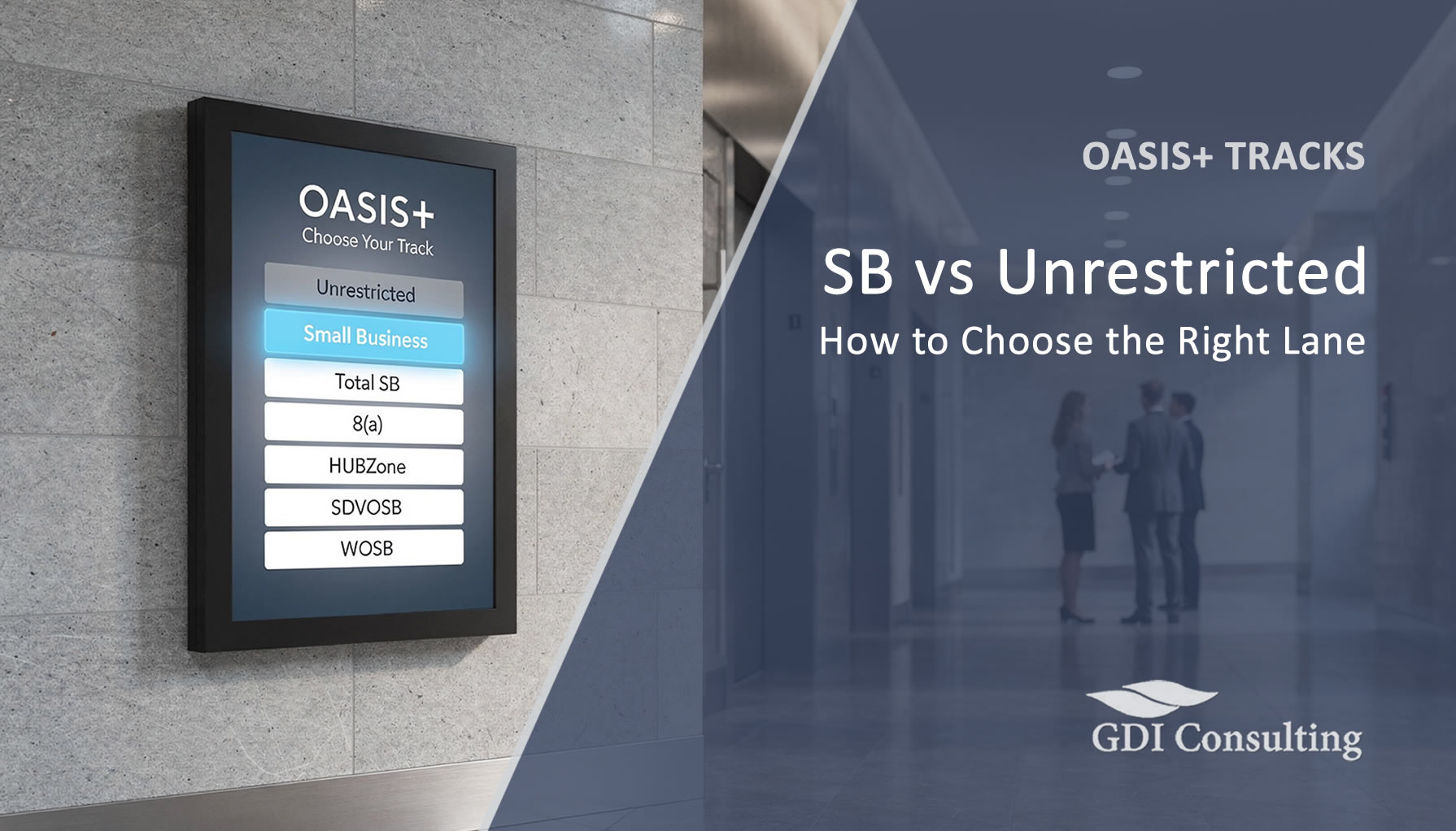
On GSA’s contracts page, you’ll see the program organized into six lanes (tracks):
- Total Small Business (SB)
- SBA-Certified 8(a)
- SBA-Certified HUBZone
- SBA-Certified SDVOSB
- SBA-Certified WOSB
- Unrestricted
If you need to verify certification status or start an application, the quickest entry point is MySBA Certifications and the SBA program pages for 8(a), HUBZone, and WOSB.
How to Choose OASIS+ track in 5 steps
Step 1: Start with your size reality, not your preference
Before you Choose OASIS+ track, confirm whether you are small for the work you actually plan to pursue. If you’re not small, Unrestricted is your lane. If you are small, you still have a decision between Total SB and a socioeconomic lane.
Step 2: If you’re small, confirm whether you’re certified right now
Socio lanes are tied to SBA certification. Validate your current status early so you don’t build a plan around a lane you can’t use at award time. Start at MySBA Certifications and your relevant SBA program page.
Step 3: Pick the lane where your competitive advantage is strongest
Use this simple decision logic:
- Unrestricted: best when you’re not small (or you’ll outgrow small quickly)
- Total Small Business: best when you’re small but not positioned for a socio lane (or timing doesn’t work)
- Socio lanes (8(a)/WOSB/SDVOSB/HUBZone): best when you’re certified and want a lane where every competitor must meet the same socio requirement
If you’re weighing entry timing, compare OASIS+ Phase II vs On-Ramp and the quick reference page OASIS+ On-Ramp.
Step 4: Choose OASIS+ track based on scoreability, not optimism
This is where most rework happens. Teams pick a lane, then discover their documentation can’t support the score they assumed. If you haven’t already, read OASIS+ scoring pitfalls and keep GDIC’s OASIS+ solicitation guide open while you build your evidence list.
If cost concerns are slowing your team down, this companion piece helps set expectations: OASIS+ proposal cost. For official training and templates, use GSA’s OASIS+ resources page.
Get a track decision tied to your evidence
If you want to Choose OASIS+ track with confidence, the fastest path is a structured score-and-proof review. GDIC’s Eligibility Assessment maps your projects to the right lane, flags documentation gaps, and shows whether you should pursue as a prime or close the gap through teaming.
Step 5: Decide prime vs CTA/JV based on the gap you need to close
If you’re close but not quite there, teaming can be the fastest way to close past performance, scope coverage, or staffing gaps. For deeper guidance, see OASIS+ self-scoring documentation and teaming and OASIS+ rolling awards and early preparation.
If you’re actively searching for teammates, GDIC’s Partnering Portal is built for this scenario.
Quick comparison: which track fits you?
Use this as a fast gut-check while you Choose OASIS+ track.
| Track | Best fit when… | Watch-outs |
|---|---|---|
| Unrestricted | You’re not small for target work | Broadest competition; proof discipline matters |
| Total Small Business | You’re small but not (or not yet) socio-certified | You still compete with socio smalls in this lane |
| 8(a) | You are an active SBA 8(a) participant | Confirm status and timing for award |
| HUBZone | You are SBA-certified HUBZone | Certification timing matters |
| SDVOSB | You are SBA-certified SDVOSB | Certification timing matters |
| WOSB | You are SBA-certified WOSB | Certification timing matters |
Need a CTA/JV partner?
If your score is close but not quite there, the right teaming approach can be the difference between “not ready” and “submit.” Connect with companies actively building OASIS+ teams.
Three common mistakes (and how to avoid them)
Mistake 1: Treating track choice as admin work
Track choice is strategy. Decide the lane first, then build your submission plan and evidence checklist.
Mistake 2: Assuming Total SB means “no socio competition”
Total SB includes all small businesses, including those with socioeconomic designations. If you want the tightest pool aligned to your certification, evaluate the relevant socio lane and confirm your certification timing on MySBA Certifications.
Mistake 3: Building binders before you confirm proof expectations
Self-scoring lives or dies by documentation quality. Align on proof requirements, then build your evidence list once. A strong shortcut is to review OASIS+ scoring pitfalls and keep the OASIS+ solicitation guide open as you draft your binder plan.
Avoid rework
Before you build binders, review common scoring pitfalls and real preparation patterns from OASIS+ case studies. It’s the easiest way to build proof once, not twice.
When you have multiple options, how to Choose OASIS+ track
If you can reasonably pursue more than one lane, prioritize in this order:
- The lane that matches your near-term pipeline and likely buyers
- The lane where your score is strongest and most defensible
- The lane where teaming requirements are realistic, if needed
If your team prefers webinar learning, browse GDIC’s Phase I/Phase II webinars.
Recommended next steps
- Confirm official structure and track names: OASIS+ contracts (GSA)
- Align your plan to submission mechanics: OASIS+ solicitation guide (GDIC)
- Get a go/no-go tied to your projects: OASIS Eligibility Assessment Service
- Get execution support if needed: OASIS+ Phase II support services and proposal support plans
- If you need partners, start early: Partnering Portal
Choose your next step
Pick the path that matches where you are today: confirm the basics, get a go/no-go, or execute with a structured plan.
DIY: Confirm the official track structure on GSA’s OASIS+ contracts page.
Guided: Get a score-and-proof review with the Eligibility Assessment.
Done-for-you: Use proposal support plans to execute the submission.
FAQ
Is OASIS+ only for large businesses?
No. OASIS+ includes Total Small Business and multiple socioeconomic tracks, plus Unrestricted. The official list is on GSA’s OASIS+ contracts page.
Where do I apply for SBA certification?
Start at MySBA Certifications and use the SBA program page that matches your situation.
Where do I find official OASIS+ templates and guidance?
Use GSA’s OASIS+ resources page and the main OASIS+ overview.
What if I can’t clear thresholds as a prime?
That’s often a teaming decision. Start with self-scoring documentation and teaming, and if you need partner matching, use the Partnering Portal.
