
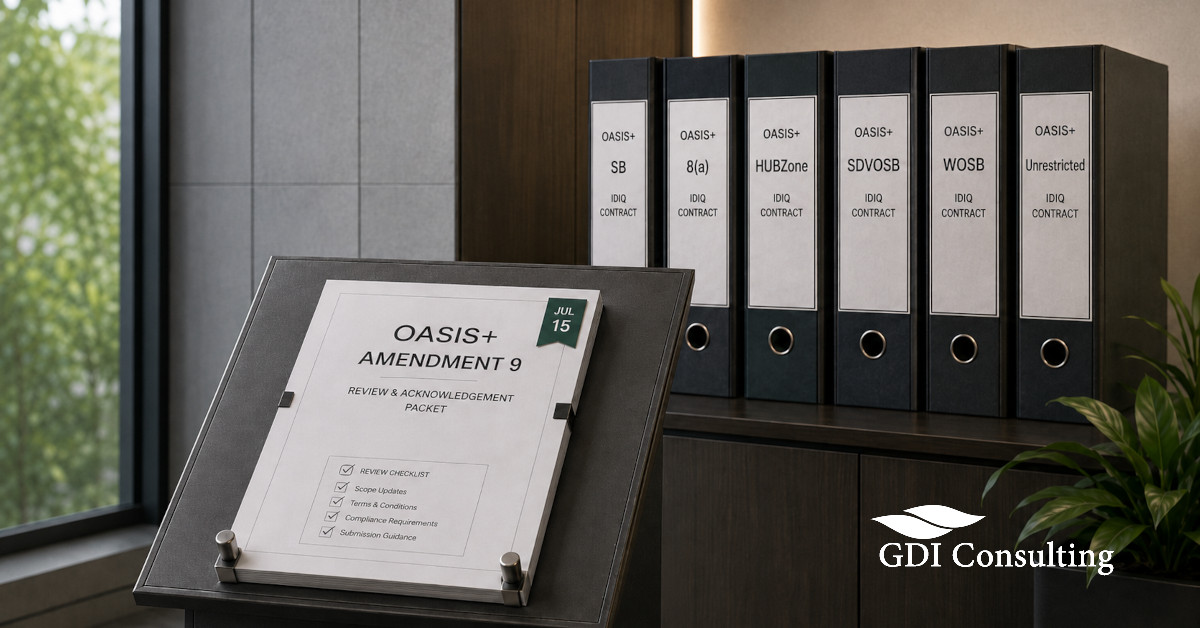
GSA issued OASIS+ Amendment 0009 across all six OASIS+ solicitations on July 7, 2026. Commonly referred to as OASIS+ Amendment 9, it creates an immediate acknowledgement requirement for certain pending offerors and makes broader changes to proposal acceptability, qualifying-project evidence, joint ventures, rejected offers, lateral springboarding, Add Domain Modifications, and contract administration.
The July 15 action is narrow, but the amendment itself is not. Contractors should address the acknowledgement first, then review the conformed RFP and revised attachments that apply to their contract family before relying on an earlier submission strategy or document set.
What Offerors Need To Know
A pending offeror that submitted before OASIS+ Amendment 9 and has received neither an award nor an unsuccessful-offer notice must sign the applicable SF 30 and upload it to the Business Factors section in Symphony by July 15, 2026.
The acknowledgement cannot be used to revise, supplement, or cure the pending offer. A new offer submitted after the amendment must acknowledge the current amendments through the OASIS+ Submission Portal and include a signed SF 33, but generally does not require a separate signed SF 30 upload.
Who Must Acknowledge OASIS+ Amendment 9?
The acknowledgement requirement applies across the Total Small Business, 8(a), HUBZone, SDVOSB, WOSB, and Unrestricted RFPs. It applies when an offer was submitted before Amendment 0009 and remains pending because GSA has not issued either a contract award or an unsuccessful-offer notice.
The offeror must sign the SF 30 for the applicable RFP and upload it in Symphony under Business Factors no later than July 15. An offeror with pending submissions under multiple OASIS+ RFPs must upload the correct signed SF 30 separately under each applicable RFP.
This is not a routine administrative preference. The amendment states that failure to associate the signed SF 30 with a pending offer by the deadline may make the offer ineligible for further consideration.
Pending-Offer Acknowledgement Checklist
- Confirm whether the offer remains pending.
- Use the SF 30 issued for the correct OASIS+ RFP.
- Complete and sign the required acknowledgement fields.
- Upload the signed form to Business Factors in Symphony.
- Repeat the process for every applicable RFP.
- Complete the upload by July 15, 2026.
What Pending Offerors Cannot Change
The signed SF 30 is for amendment acknowledgement only. GSA expressly states that the acknowledgement may not be used to revise the offer, add supporting documentation, supplement the claimed score, or cure an existing deficiency.
That distinction matters. A pending offeror should complete the required acknowledgement without treating the July 15 process as an opportunity to correct or strengthen the underlying proposal. Any material submitted beyond the required acknowledgement could create a separate compliance issue rather than improve the offer.
What New Offerors Must Do
Offerors submitting after Amendment 9 must acknowledge all current amendments through the required action in the OASIS+ Submission Portal. A signed SF 33 remains part of every new offer. A separate signed SF 30 is generally not required for a new submission unless GSA directs otherwise.
The more important readiness issue for new offerors is that the proposal should now be built against the conformed Amendment 0009 RFP and current attachments. Earlier templates, scorecards, verification forms, and cost-price files should not be assumed to remain acceptable merely because the underlying business facts have not changed.
Acceptability Is A Separate Gateway
The amended evaluation language clarifies that GSA reviews proposals through separate stages: acceptability, technical qualification, responsibility, and fair and reasonable pricing. An offer that fails the initial acceptability review can be removed before GSA evaluates whether its technical score is otherwise sufficient.
The acceptability review includes foundational submission items such as the signed SF 33, current size representations, required joint-venture or subcontractor documentation, commitment letters when applicable, required CTA documentation, the current cost-price template, indirect-rate support, financial data, and sufficient claimed credits for the proposed domain.
The practical message is straightforward: a competitive self-score does not protect an offer that is incomplete, inconsistent, or built with the wrong submission documents.
Project Evidence And Scorecard Changes
OASIS+ Amendment 9 also changes how contractors should assemble and verify project evidence. The revised Project Verification Form incorporates applicable qualifying-project scale thresholds, including reduced thresholds for qualifying protégé projects, and supports relevance documentation across additional domains.
The amendment repeatedly reinforces the requirement to provide the applicable original award form when a project is used as a Qualifying Project. The stated exception is a project claimed solely for Federal Experience credit rather than as a Qualifying Project.
For non-federal projects and federal subcontracts, the Past Performance Rating Form must be completed and signed by a corporate officer or customer official with cognizance over the project. CMMC self-assessment credit requires official evidence that the assessment was accepted or recognized by the government. GSA also added more explicit support for the indirect-cost-rate Basis of Estimate.
The revised scorecards and supporting attachments clarify several areas, including qualifying-project management and staffing, personnel clearances, Enterprise Solutions locations, approved systems and rates, and certain certifications. Unrestricted offerors should also review the revised auto-relevant NAICS treatment for the Enterprise Solutions Domain.
A Significant MPJV Project Requirement
For an SBA mentor-protégé joint venture, at least one Relevant Qualifying Project for each proposed domain must come from the protégé or from the offering mentor-protégé joint venture itself. A project supplied through a Meaningful Relationship Commitment Letter cannot satisfy that minimum protégé-project requirement.
This is a substantive planning issue for teams that expected mentor, subcontractor, or other committed-entity experience to carry most of the domain case. The project mix should be reviewed domain by domain before the offer is finalized.
Previously Rejected Offers Must Start Again
A previously rejected offer cannot simply be reopened, updated, and returned for another evaluation. The offeror must prepare and submit a new proposal in the OASIS+ Submission Portal.
The new submission must include a signed company-letterhead response addressing each finding in the prior debriefing letter. The stated exception is a previously rejected lateral springboarding request. This requirement makes the prior debriefing a central compliance document for any resubmission strategy.
Changes For Current OASIS+ Awardees
The amendment also affects companies that already hold an OASIS+ contract. Updated lateral springboarding rules limit the process to eligible small-business contract families and confirm that lateral springboarding is not available to the Unrestricted contract family. Requests must rely on eligible existing team members, original successful proposal projects, and currently awarded domains.
Add Domain Modifications remain available only while the applicable solicitation and requested domain are open. The contractor must be active, current on required contract modifications, meet the current solicitation requirements, provide current size representations, and satisfy the qualification threshold for the new domain.
For an Add Domain request, GSA will not accept a new price proposal or responsibility package unless the contracting officer requests one. Contractors may add qualifying projects and subcontractors for the proposed domain, but adding a larger subcontractor can affect the team’s size status and potentially place existing CLINs or domains into Dormant Status.
Amendment 0009 also clarifies that later continuous-open awards may receive a shorter remaining contract term because all contracts within a contract family share the same final end date. Other administration changes address C-SCRM timing, BPAs, ancillary IT, and use of other government sources of supply.
Where The Six RFPs Differ
The acknowledgement rule is common, but the amendment is not identical across the six contract families. GSA lists between 47 and 49 changes depending on the RFP.
| Contract family | Important distinction |
|---|---|
| Total Small Business | Follows the common small-business framework without the additional certification-specific prime-offer limitation found in the four socioeconomic RFPs. |
| 8(a), HUBZone, SDVOSB and WOSB | A certified concern previously awarded through a joint venture is limited in a later prime offer to domains that are not active under the joint venture’s awarded contract. Each RFP also applies its own certified-concern project requirements. |
| HUBZone | GSA may verify SBA HUBZone certification through the SBA search system and/or SAM.gov, rather than treating SAM.gov as the sole controlling display. |
| Unrestricted | Includes additional Enterprise Solutions CLIN changes, confirms that size- or socioeconomic-based set-asides are prohibited under the Unrestricted contract, and does not permit lateral springboarding. |
What Contractors Should Review Now
The first priority is to determine whether the July 15 acknowledgement applies. After that, the review should be based on the contractor’s current position:
- Pending offerors: submit the correct acknowledgement without attempting to alter the proposal.
- New offerors: rebuild the submission checklist around the conformed RFP and current attachments.
- MPJVs and team-based offerors: retest project sourcing, certified-concern requirements, size representations, and commitment documentation.
- Previously rejected offerors: prepare a new submission strategy tied directly to every debriefing finding.
- Current awardees: review the revised Add Domain, springboarding, size-status, and contract-administration rules before taking the next action.
Need To Reassess Your OASIS+ Position?
OASIS+ Amendment 9 does not require every contractor to take the same next step. It does require pending offerors to address the immediate acknowledgement and gives new offerors, prior applicants, team-based bidders, and current awardees several reasons to reassess the strength and compliance of their current path.
The Practical Takeaway
The most urgent requirement is clear: qualifying pending offerors must upload the signed, RFP-specific SF 30 by July 15, 2026. That acknowledgement is mandatory but cannot be used to repair the offer.
Beyond the deadline, Amendment 0009 materially changes the submission and post-award framework. Contractors should not treat it as a one-page signature exercise. The correct response is to complete the immediate acknowledgement where required, then review the applicable conformed RFP, scorecards, project-verification documents, and modification rules against the contractor’s actual pursuit or contract position.
Official sources: GSA OASIS+ program page; Total Small Business RFP; 8(a) RFP; HUBZone RFP; SDVOSB RFP; WOSB RFP; and Unrestricted RFP.
This article summarizes the amendment for planning purposes. Offerors and contractors should rely on the SF 30, conformed RFP, and attachments issued for the applicable solicitation.
