
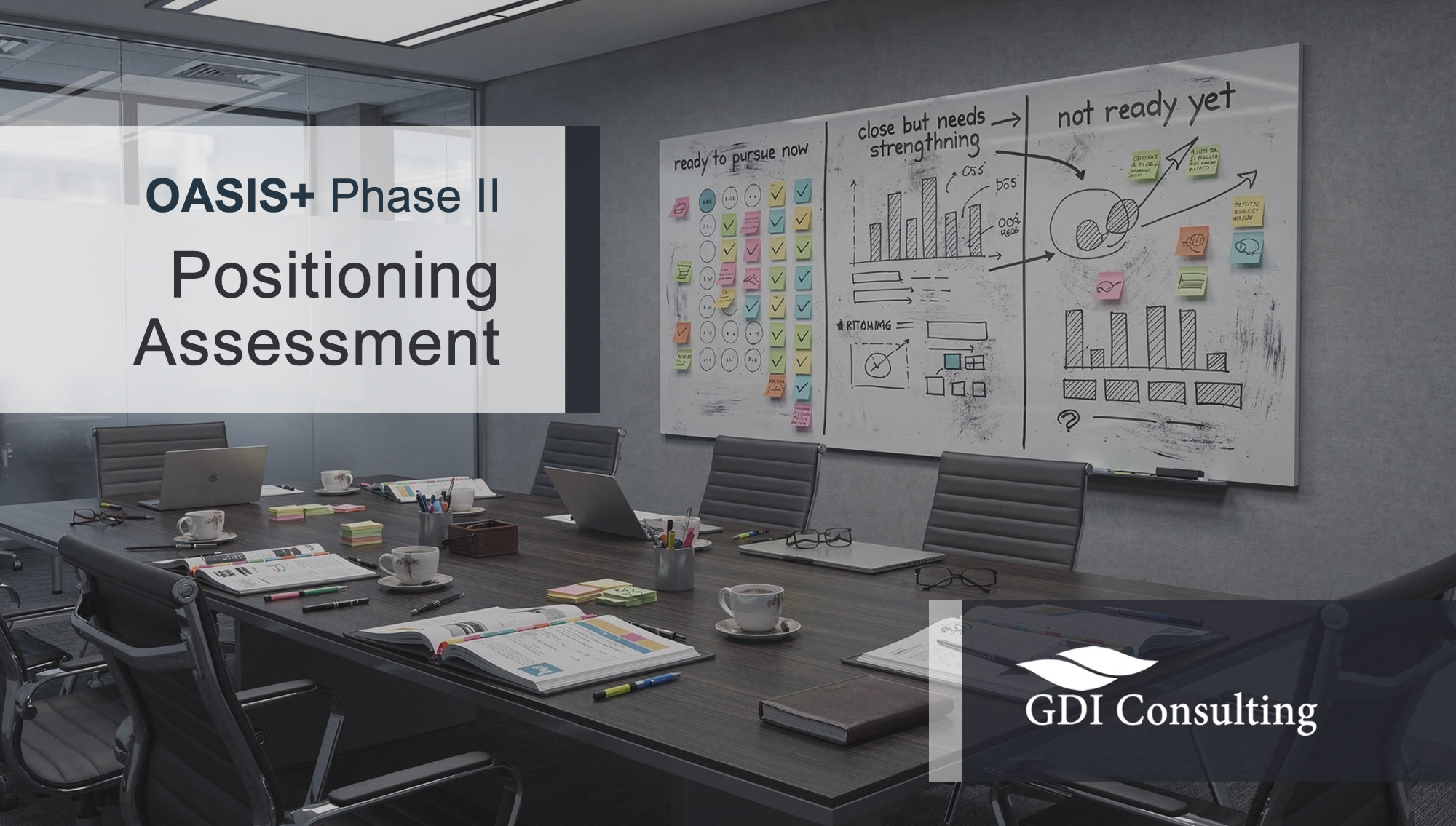
The shift to a continuously open Phase II environment changed timing pressure, but it did not remove the need for disciplined judgment. As reflected on the official GSA OASIS+ program page, a serious OASIS+ Phase II Assessment is no longer centered on whether a deadline can be met. It is centered on whether the firm is presently in a credible position to pursue, close enough to strengthen deliberately, or better served by holding until its case is materially stronger..
Quick Answer
A sound OASIS+ position assessment should distinguish among three conditions: ready now, close but not ready yet, and not ready yet. That judgment should be grounded in domain fit, probable competitiveness, project support, documentation quality, and the practical route available to the firm, whether that means moving now, strengthening first, pursuing a team-based strategy, or following a capture-first path.
Why Position Assessment Matters More Now
A fixed deadline tends to force clarity. Leadership either commits, declines, or accepts the consequences of waiting. A continuously open environment operates differently. It gives firms more room to think, but it also gives them more room to remain in evaluation mode without reaching a disciplined conclusion.
That is why the practical issue has shifted. The question is not whether contractors should feel artificial urgency. The question is whether they can make a credible assessment of current position. Firms that do that well will usually make better decisions than firms that mistake extra time for automatic readiness.
A sound OASIS+ Phase II Assessment is useful only if it helps leadership classify where the firm actually stands. The objective is not to simplify a complex opportunity into a slogan. It is to create a cleaner basis for judgment.
That judgment becomes clearer when leadership distinguishes among three practical positions rather than treating every interested contractor as if it were equally prepared to move.
The Three Positions Leadership Should Distinguish
Most contractors evaluating Phase II fall into one of three broad positions. These categories are not academic. They are a practical way to separate serious pursuit readiness from uncertainty that still needs to be resolved.
- Ready now when the domain fit is defensible, the likely position appears credible enough to justify effort, and the supporting record is strong enough to sustain an active submission strategy.
- Close but not ready yet when the opportunity may be viable, but important elements still need to be strengthened before leadership can justify moving with confidence.
- Not ready yet when the current case is not strong enough and the firm would be better served by defining improvement conditions before revisiting the decision.
This matters because the real choice is rarely between immediate action and indefinite waiting. Most firms need a more disciplined middle analysis than that.
What A Ready Position Looks Like
A ready position begins with defensible domain fit. The target domain should align with work the firm can support persuasively, not merely work that is adjacent in a broad marketing sense. The probable position should also appear credible enough to justify serious investment of leadership attention, internal resources, and submission effort.
Just as important, the project base and supporting materials should be strong enough to reduce dependence on optimistic assumptions. A firm in a ready position does not need every unknown removed. It does need enough clarity that leadership is no longer debating the same threshold questions about fit, evidence, and viability.
In other words, ready now does not mean perfect. It means the firm has a defensible basis for action.
What A Close Position Usually Means
Many firms are neither clearly ready nor clearly out. They are close. That can be a strong position if it is treated as a defined improvement stage. It becomes a weak position only when it turns into passive delay.
A close position usually means that one or more critical components remain unsettled. The target domain may be directionally right, but project selection may still need refinement. The probable position may look promising, but not yet sufficiently supportable. Documentation may exist, but not in a form that gives leadership confidence. Internal ownership may still be diffuse. Or the better route may ultimately be a team-based strategy rather than a standalone pursuit.
For a firm in this category, the important question is not whether to keep watching. It is what specific deficiencies must be resolved before leadership can make a cleaner decision.
Why Not Ready Yet Can Be The Most Disciplined Answer
Not ready yet is not a failed answer. In many cases, it is the most responsible answer available. A firm may lack a sufficiently strong domain case. The available project record may not support a credible competitive position. Documentation may be too thin. Or the company may need a longer preparation cycle before a serious submission effort is justified.
The problem is not a not-ready conclusion. The problem is when that conclusion is never stated clearly and is instead hidden inside prolonged discussion. Continuous open can make that easier. Teams keep reviewing possibilities, but they do not define the conditions under which the decision would change.
A disciplined not-ready conclusion should identify what is weak, what must improve, and what future condition would justify revisiting the opportunity.
Questions Leadership Should Be Able To Answer
- Is the target domain genuinely supported by work we can defend?
- Does our likely position appear strong enough to justify active pursuit?
- Is our project and documentation base sufficient to support the case we would need to make?
- Is the right route to proceed now, strengthen first, pursue a team-based strategy, or follow a capture-first path while improving?
A Practical Assessment Standard
The most useful assessment sequence is straightforward. First, confirm domain fit. Second, examine the firm’s probable position with enough rigor to determine whether active pursuit is justified. Third, review whether the project record and supporting documentation can sustain the case the firm would need to make. Fourth, evaluate route, because the strongest answer may not always be a direct standalone pursuit.
That standard matters because an effective OASIS+ Phase II Assessment must go beyond calendar pressure and test the actual strength of the firm’s position. They are blocked by uncertainty about the strength of their own case. Without a structured assessment, leadership can spend significant time discussing an opportunity without determining whether the underlying position is truly credible.
If those four areas cannot be answered with reasonable confidence, the immediate need is usually not acceleration. It is clarity.
Why Continuous Open Raises The Value Of Clarity
In a fixed-deadline environment, the market itself applies pressure. That pressure is not always comfortable, but it tends to expose whether a firm genuinely believes in its own case. In a continuously open environment, uncertainty can remain unresolved for much longer because there is no single date forcing leadership to decide.
That makes structured self-assessment more important, not less. The absence of a visible forcing function does not reduce the need for judgment. It increases the need for internal discipline. Firms that understand where they stand can choose a path with more confidence. Firms that do not may remain in observation mode well beyond the point where useful judgment should have been made.
The practical objective, then, is not speed for its own sake. It is a more defensible position call.
Need A Clearer View Of Where Your Firm Stands?
For firms that are still evaluating whether they are ready now, close but not ready yet, or not ready yet, the most useful next step is a structured fit review. Our OASIS+ Phase II fit review page lays out the decision path more clearly and helps firms move from broad uncertainty toward a more defined next step. Where the situation is more complex, consultation remains the softer path.
What This Means For Contractors Right Now
OASIS+ Phase II does not require every contractor to reach the same answer at the same time. It does require each contractor to reach a disciplined answer. Some firms should move. Some should strengthen. Some should pursue a team-based option. Some should hold until the case is materially stronger.
The value of a serious assessment standard is that it keeps leadership from confusing prolonged discussion with progress. It also helps firms distinguish between rational preparation and simple delay.
A strong OASIS+ Phase II Assessment does not push every reader toward the same action. It helps each firm understand which action path fits its present condition.
Conclusion
How to assess your position in OASIS+ Phase II is ultimately a question of judgment, not momentum. Continuous open changed the timing dynamic, but it did not change the need to determine whether the firm is ready now, close but not ready yet, or not ready yet for defined reasons.
Once that judgment is made cleanly, the next decision becomes more practical: whether to proceed now, strengthen first, consider a team-based route, or maintain a capture-first posture while building a stronger future case.
FAQ
If your team is still working through an OASIS+ Phase II Assessment, the most useful next step is to replace broad uncertainty with a clearer fit review or a focused consultation.
