
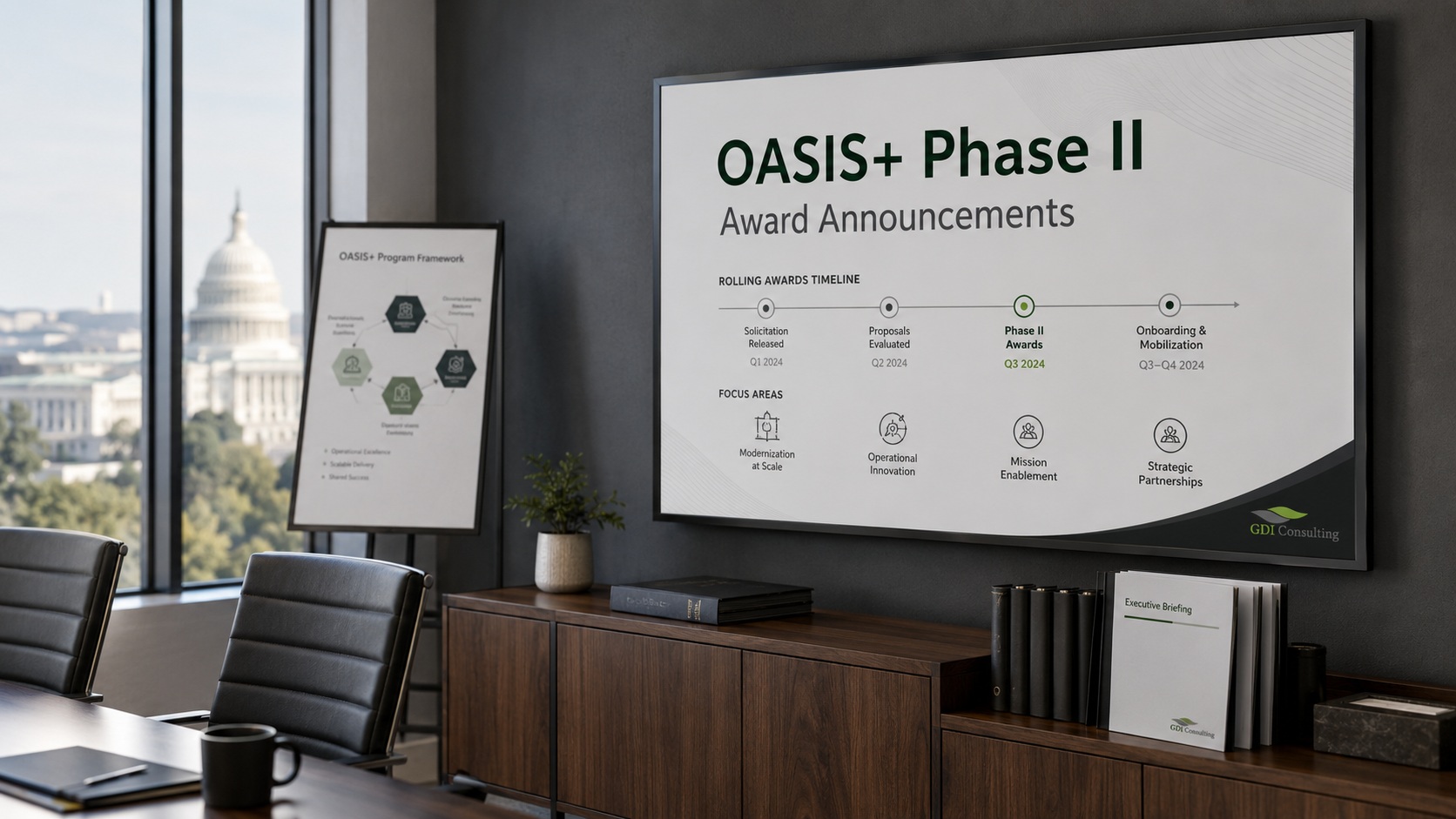
The OASIS+ Phase II award announcements should be treated as a decision signal, not as a reason for panic or drift. GSA has posted rolling apparent awardee activity while the OASIS+ solicitations continue to operate under a continuously open model. For firms still evaluating Phase II, the practical question is not whether the opportunity has suddenly become a deadline-driven race. The question is whether the firm can now make a clearer decision about what its current position supports.
That distinction matters. A rolling announcement can make the market feel more active and more concrete. It can also create pressure inside firms that have been watching OASIS+ without reaching a defined conclusion. But the better response is not to treat public award activity as a substitute for analysis. The better response is to decide whether the firm should move now, strengthen first, request broader guidance, consider a partner-based route, or hold intentionally under defined conditions.
Award Announcements Do Not Remove The Continuous Open Model
OASIS+ Phase II award announcements do not change the basic decision environment by themselves. GSA’s continuously open solicitation guidance remains the official reference point for the current submission environment. That means firms should not assume that a rolling announcement creates a hard stop where one has not been stated.
The more useful interpretation is narrower and more practical. Rolling apparent awardee announcements show that the process is active. They confirm that submissions are moving through evaluation and that public outcomes are beginning to appear. For undecided firms, that should sharpen the seriousness of the decision, but it should not replace the firm’s own judgment about readiness, evidence strength, domain fit, and route.
Continuous open gives firms flexibility. It does not give them a reason to leave the decision unresolved indefinitely.
How OASIS+ Phase II Award Announcements Should Shape The Decision
The most important question after OASIS+ award activity is not simply whether other firms are moving. The more important question is whether your own firm’s decision has matured enough to support action.
Some firms have been waiting because they needed more clarity on the solicitation environment. Others have been waiting because their internal case is not yet strong enough. Those are different situations. A firm that has a defensible domain fit, a supportable project record, and a credible position may need to move from discussion to action. A firm that still lacks evidence, documentation, internal ownership, or a clear route may need to strengthen first rather than rush a weak case.
The public announcement does not answer those questions for the firm. It simply makes the need to answer them harder to ignore.
Rolling Activity Changes The Psychology Of Waiting
Rolling award activity can change how leadership perceives waiting. Before announcements begin, some firms can treat OASIS+ as a future decision. Once apparent awardee activity is visible, the opportunity feels more current. That can be useful if it pushes the firm toward disciplined review. It can be harmful if it pushes the firm toward reactive action without a clear basis.
Waiting can still be rational under a continuously open model. It is rational when the firm knows what is missing, what must improve, and what condition would justify revisiting the decision. Waiting is weaker when it simply means keeping OASIS+ on an internal watch list without defining the unresolved issue.
The difference is ownership. A disciplined hold has a reason, a condition, and a next review point. Passive delay has none of those things.
Firms Should Separate Signals From Assumptions
OASIS+ Phase II award announcements are signals. They are not a complete interpretation of what any individual firm should do. A signal can tell leadership that the process is active, that competitors may be moving, and that continued observation has a cost. It does not prove that a firm is ready. It does not prove that a firm is too late. It does not prove that the right path is a standalone submission.
That is why firms should avoid two common overreactions. The first is assuming that apparent awardee announcements mean they must rush. The second is assuming that continuous open means they can postpone the decision indefinitely. Both reactions avoid the harder question: what does the firm’s actual position support now?
A more disciplined review should test the practical issues that determine the next step:
- Whether the target domain is genuinely supported by work the firm can defend.
- Whether the project record and documentation are strong enough to support the intended case.
- Whether leadership can justify moving now or should strengthen first.
- Whether a partner-based route is more realistic than a direct standalone pursuit.
- Whether holding is intentional, documented, and tied to clear future conditions.
The Stronger Response Is A Decision Review, Not A Rush
The strongest response to OASIS+ Phase II award activity is not automatic acceleration. It is a cleaner decision review. Firms should use the current moment to determine which path they can justify, not to force every situation into the same answer.
For some firms, the decision review may support moving now. They may have a defined domain, a credible evidence base, and enough internal confidence to proceed. For others, the answer may be to strengthen first because the current case is promising but not yet supportable. Some firms may need broader guidance because the issue is not limited to one domain or one eligibility question. Others may need to consider a partner-based route if the standalone case is not strong enough. And some should hold intentionally, with defined conditions for when the decision will be revisited.
That is the value of a decision-review frame. It does not tell every firm to act the same way. It forces the firm to identify what its present position can support.
What Leadership Should Decide Now
Leadership does not need to resolve every OASIS+ question before taking the next step. It does need to stop treating unresolved questions as if they are the same as strategy.
After rolling award activity appears, the more useful leadership discussion is straightforward. If the firm believes it is ready, what evidence supports that conclusion? If the firm is close but not ready, what specifically must improve? If the firm is uncertain, is the uncertainty about domain fit, project support, competitiveness, route, or internal commitment? If the firm wants to wait, what future condition would change the decision?
Those questions are more useful than broad interest. They create a basis for action, preparation, guidance, partnering, or intentional hold. They also reduce the risk that continuous open becomes a reason to leave OASIS+ permanently unresolved.
Conclusion
OASIS+ Phase II award announcements make the market feel more active, but they do not replace disciplined judgment. The continuously open model remains important because it gives firms room to make a more deliberate decision. At the same time, visible rolling activity should make firms more careful about indefinite evaluation.
The right response is not artificial urgency. It is decision discipline. Firms should use this moment to determine whether they can move now, need to strengthen first, should request broader guidance, should consider a partner-based route, or should hold intentionally with defined conditions.
For firms that need a clearer way to make that judgment, GDIC’s current decision-review resource can help leadership review the decision path more directly.
