
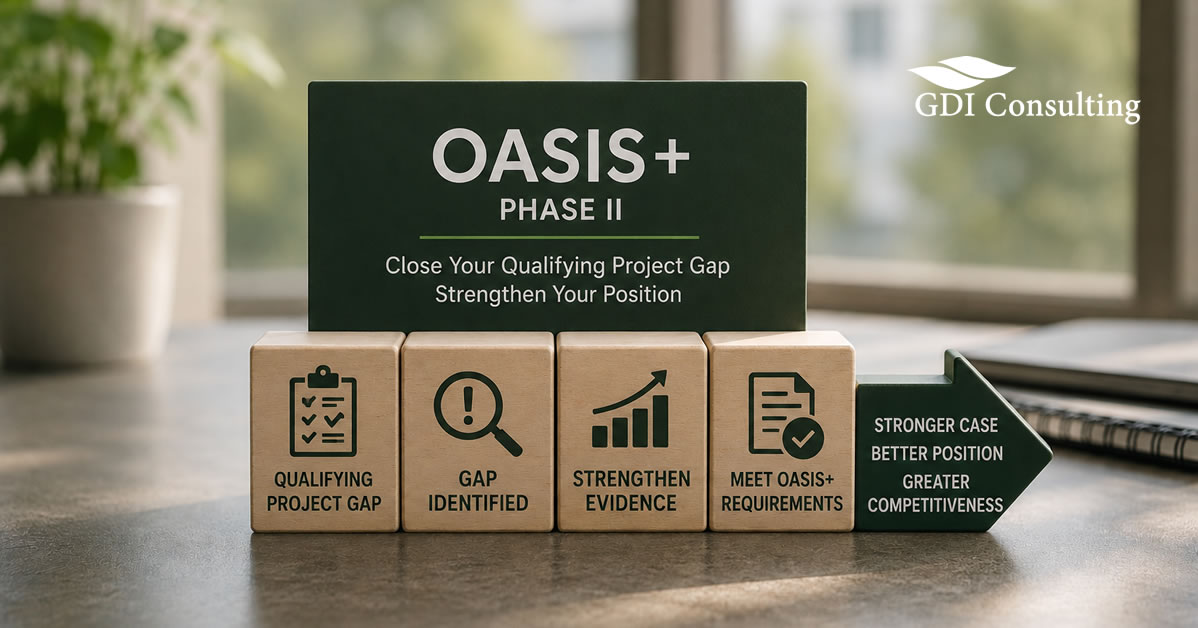
An OASIS+ qualifying project gap is often treated as a simple shortage: the firm counts its projects, compares that count to the domain it wants, and concludes that the file is not ready. That may be true. But the count is only the surface. In OASIS+ Phase II, the more useful question is whether the contractor has examined the full evidence architecture available to support a defensible position.
GSA states that OASIS+ requires vendors to demonstrate project experience relevant to the scope of the contract, and it directs offerors to the Domain Qualifications Matrix and Scorecards for the qualifying threshold. GSA also states that an offeror may submit a maximum of five distinct qualifying projects for each domain, and those projects can include several forms of experience, including prime contracts, subcontracts, commercial contracts, task orders, certain schedule orders, OTA awards, and a defined collection of task orders, when the solicitation criteria are met. GSA OASIS+ qualification page
That does not make every project usable. It means a contractor should be careful before deciding that one missing project automatically ends the analysis. The actual review should look at the target domain, available project record, relevance, annual value, timing, past performance, documentation, and whether a compliant team-based route changes the strength of the submission picture.
Core Point
An OASIS+ qualifying project gap should trigger an evidence review, not an automatic retreat. A contractor with fewer than five apparent projects may still need to examine whether the existing record, selected domain, documentation support, and any compliant team-based structure can create a credible OASIS+ position.
Reading The OASIS+ Qualifying Project Gap
Many firms describe their OASIS+ issue as a missing project. One project is still underway. One ended too long ago. One looks relevant in substance but carries the wrong code. One was performed as a subcontractor. One has strong scope but weak documentation. Another has the right customer and value but does not clearly map to the target domain.
Those are different problems. A project that cannot meet the minimum criteria is a threshold problem. A project that may meet the criteria but cannot prove relevance is a documentation and mapping problem. A project that is valid but weak for the selected domain may be a domain-selection problem. A project performed by a potential teammate raises a route and compliance problem.
The first mistake is assuming the count alone answers the question. The second is assuming the only useful evidence is the company’s most obvious prime-contract history. OASIS+ requires discipline because the evidence question is more layered than that.
First, The Filters
A qualifying project has to pass through several filters before it helps an OASIS+ position. GSA states that QPs must meet minimum criteria, including being a qualifying contract or order type, being a contract or order for services, meeting or exceeding the required Average Annual Value for the proposed domain, being ongoing with at least six months of completed performance from the RFP closing date or completed within the specified five-year period before June 15, 2023, and not having an associated record of negative past performance. GSA qualifying project criteria
That is why a contractor should not begin with a marketing view of its best work. It should begin with a solicitation view of what the project can actually carry. The internal story may be strong, but the OASIS+ record still has to answer formal questions: what was the instrument, what services were performed, what value can be supported, when was the work performed, what past performance history attaches to it, and how the project connects to the target domain.
Domain Drives Proof
A project does not become persuasive merely because it was large, successful, or performed for a federal customer. Under OASIS+, relevance is tied to the proposed domain. GSA states that an offeror may claim credits under “QP – Relevance” only if the QP is relevant to the scope of the proposed domain, and that relevance may be demonstrated through automatic or standard relevance verification. GSA relevance criteria
This changes the meaning of an OASIS+ qualifying project gap. The firm may not be short on strong work. It may be short on evidence that proves the specific domain it wants. A contractor can have a credible professional services record and still struggle if the selected domain requires a more exact scope story than the documents can support.
A firm may be short for one domain and more supportable in another. It may have enough projects but not enough relevance. It may have relevance but not enough value. It may have value and relevance but lack the documents needed to substantiate them. Those conditions should not be collapsed into a single conclusion.
Do Not Dismiss Other Experience
Some contractors assume OASIS+ evidence must come from prime federal contracts only. That assumption can be too narrow. GSA’s QP description includes a single contract, including prime contracts, subcontracts, and commercial contracts, as one possible project classification if the project meets the applicable criteria. GSA QP classifications
That point should be handled carefully. It does not mean subcontract or commercial experience automatically solves a gap. It means those records should be examined rather than ignored. A subcontract may have strong technical relevance but require careful documentation. A commercial contract may show domain-aligned services but need a more exact support file. A federal task order may look relevant in memory but require the right award documents, PSC, NAICS, scope text, or standard relevance support.
In that sense, the gap is not always solved by finding another project. Sometimes it is clarified by reading the existing record more precisely and separating usable evidence from unsupported assumptions.
Teaming Changes The Evidence
When a firm’s standalone record is thin, a team-based route may deserve review. GSA identifies permitted teaming arrangements under OASIS+, including contractor teaming arrangements, joint ventures, and proposed small-business subcontractors. GSA OASIS+ teaming structures
The important word is review. Teaming is not a casual patch for missing qualifications. It changes the analysis because the evidence, business structure, size implications, documentation obligations, and scoring consequences must be read together. A project from a proposed team member may help only if the solicitation permits it in the relevant context and only if the support record is strong enough to withstand evaluation.
The team question should therefore be framed as a structural question, not a shortcut. Does the contemplated structure fit the OASIS+ rules? Does the added experience address the specific domain gap? Does it improve the record enough to justify the added complexity? Are the team member’s size, role, documents, and commitments consistent with the route being considered?
The Credit Box View
A more mature OASIS+ review treats the company’s record like a credit box. Each candidate project is tested for what it can actually contribute: threshold eligibility, domain relevance, value, recency, past performance, customer type, documentation strength, and relationship to other available evidence. Each possible route is then tested for whether it improves that box or merely makes the pursuit more complicated.
A contractor with fewer than five apparent projects may still have a reviewable case if the projects are strong, relevant, documented, and properly aligned with the selected domain. A contractor with five projects may still have a weak case if the projects are marginal, poorly documented, misaligned, or dependent on assumptions the solicitation will not reward. The count matters, but it is not the whole analysis.
A pending project may be worth waiting for if it materially improves the credit box. It may not be worth waiting for if it adds another example without fixing relevance, value, or documentation weaknesses. A team-based route may be worth examining if it directly improves the evidence position under a compliant structure. It may not be worth pursuing if it adds complexity without solving the specific gap.
What The Gap Should Reveal
The best use of an OASIS+ qualifying project gap is diagnostic. It should reveal whether the firm has a true threshold problem, a domain-selection problem, a relevance problem, a documentation problem, or a structure problem. Those are not the same issue, and they should not lead to the same conclusion.
A true threshold gap may require more time or a different future record. A domain gap may require selecting a more supportable domain. A relevance gap may require stronger mapping between project scope and the domain requirement. A documentation gap may require building the file behind the projects already performed. A structure gap may require evaluating whether a compliant team-based route changes the position.
Conclusion
An OASIS+ qualifying project gap should not be treated as a slogan or a dead end. It should be treated as an evidence problem. The firm may truly be short. It may be pursuing the wrong domain. It may have useful subcontract, commercial, task-order, or other qualifying experience that has not been evaluated correctly. It may need stronger documentation. It may need to examine whether a compliant team-based route changes the position.
For firms that are short on project evidence but still interested in OASIS+ Phase II, the next step is not to guess. It is to review whether the current record, target domain, documentation, and possible team-based route support a credible path.
GDIC’s OASIS+ Phase II Fit Review is designed for that type of position review: not a generic push toward submission, but a disciplined examination of whether the evidence, domain, and route can support a defensible OASIS+ position.
