
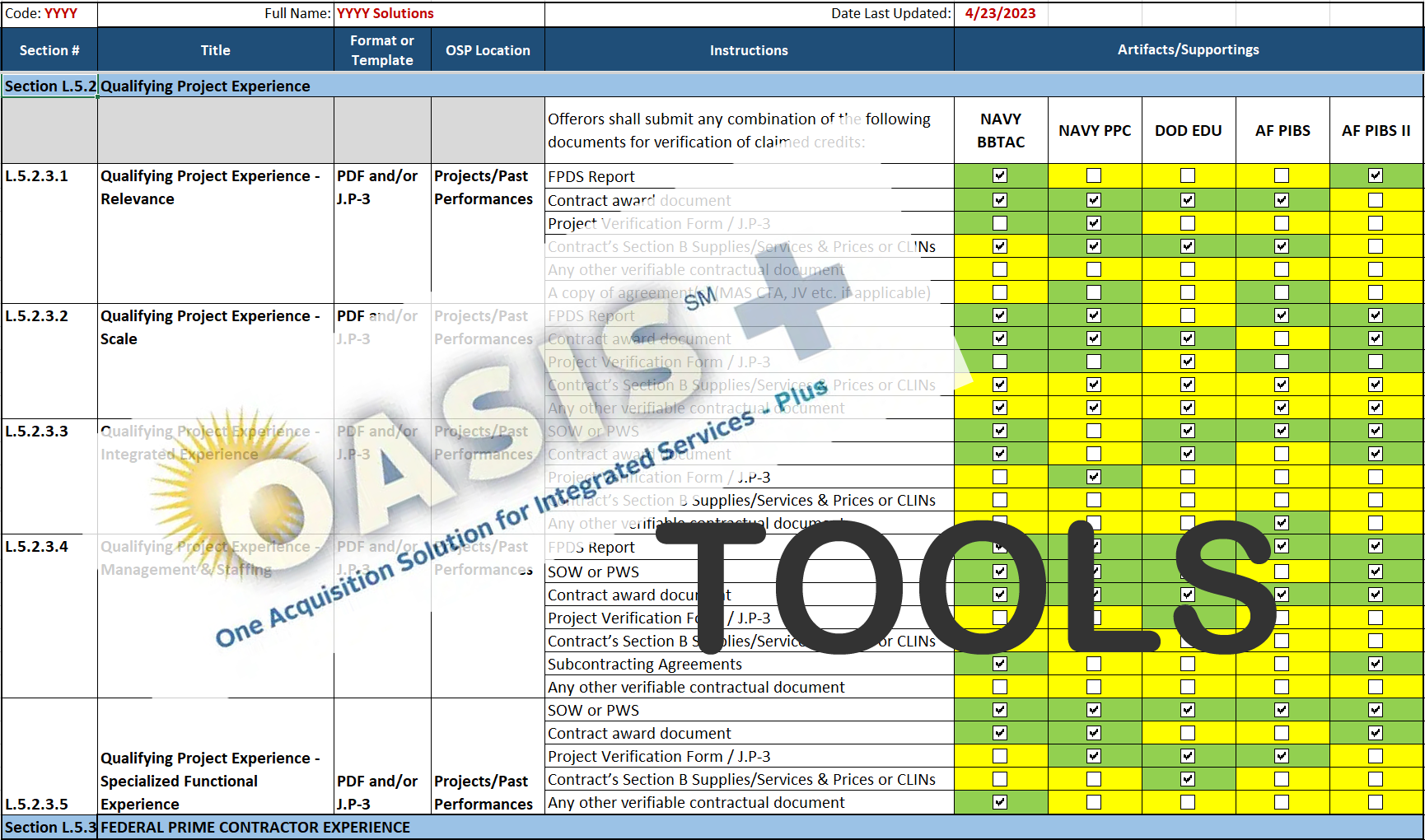
.
What OASIS Plus Tools Do You Need to Prepare Your Proposal In-House?
Introduction:
The $60B+ OASIS Plus program is a GSA contracting vehicle that provides access to a wide range of professional services. However, preparing a high-quality, compliant submission to support an award can be daunting—especially for mid-size and large businesses handling proposal preparation in-house. These teams often face a large volume of past-performance projects and inconsistencies across contract documents. Having the right OASIS Plus Tools for each phase is essential to stay organized, validate your scoring position, and reduce preventable compliance risk.
This article discusses the OASIS Plus Tools needed for each phase of an OASIS Plus submission effort. It assumes the reader has a working understanding of the requirements and the self-scoring model, including Qualifying Projects (QPs), Federal Experience Projects (FEPs), and the Systems and Certifications factors—and how these elements combine into the final score. For further reading on the scoring model, refer to our webinars on the scoring system on the GDI Consulting website.
Start with a fast, independent go/no-go and score reality check: Get An OASIS Plus Eligibility Assessment
Phasing in OASIS Plus:
Before diving into the tools, it’s important to recognize that the OASIS Plus Tools you use must align with the phase you’re in. Don’t look for a single “magical” tool that solves everything end-to-end. Instead, develop tools specific to each stage of the process—and refine them as you move forward.
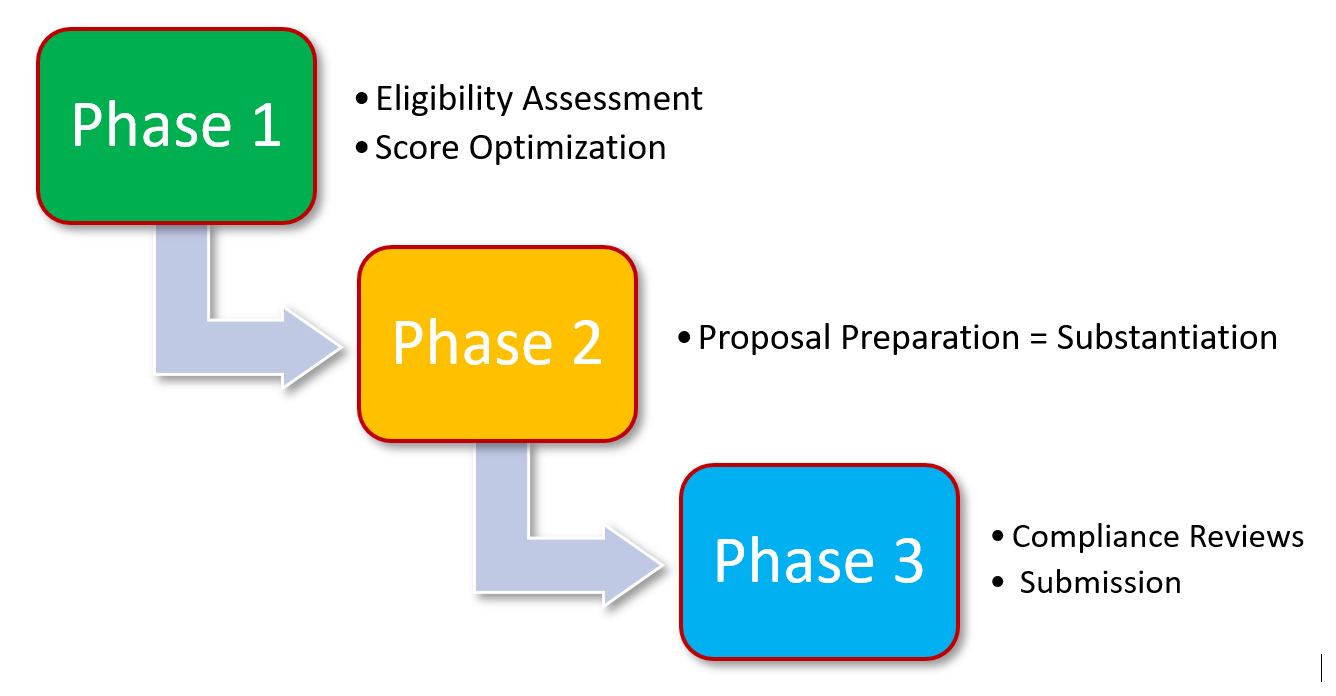
The OASIS Plus submission effort typically progresses through three phases:
Phase 1 – Eligibility Assessment and Score Optimization
Here, you decide which domains and tracks (UNR or SB) you can pursue with a realistic chance of success, identify which contracts are eligible, and select the strongest contracts from your past performance pool to maximize your score.
Phase 2 – Proposal Preparation = Substantiation
At this phase, you have decided on the domains/tracks and know which contracts you plan to use for each domain. Now you build the submission package. In self-scoring RFPs, the “proposal” is largely the substantiation of the score you established in Phase 1, using official contract documents. Phase 2 focuses on assembling the required evidence exactly as specified by the RFP so you can prove the score you claimed. Your tools should support evidence collection, organization, and substantiation control.
Phase 3 – Compliance Reviews and Submission
In Phase 3, you confirm the package assembled in Phase 2 is fully compliant with the RFP requirements and that your submission to Symphony (GSA’s online portal for submissions) proceeds smoothly. Tools at this stage should support final compliance validation, tagging readiness, and upload verification.
If you want a quick refresher on the scoring model before you build: Watch The OASIS Plus Self-Scoring Webinars
OASIS Plus Tools for Phase 1:
Tool No. 1 – Contract Selection Tool
The first tool needed in Phase 1 is a contract selection tool. This tool should help you search your archives and produce a list of contracts that meet OASIS Plus eligibility requirements, such as: annual value above the domain threshold; completion within the last five years (or ongoing with at least six months of performance); and alignment with the “Auto-Relevant” NAICS/PSC codes.
For organizations with large portfolios, many teams use database queries, structured repositories, and (where appropriate) AI-assisted search to identify candidate contracts quickly and consistently. This becomes especially useful for mid-size or large businesses with decentralized offices, where contract ownership and documentation may be distributed across multiple teams.
Tool No. 2 – Contract Profiler
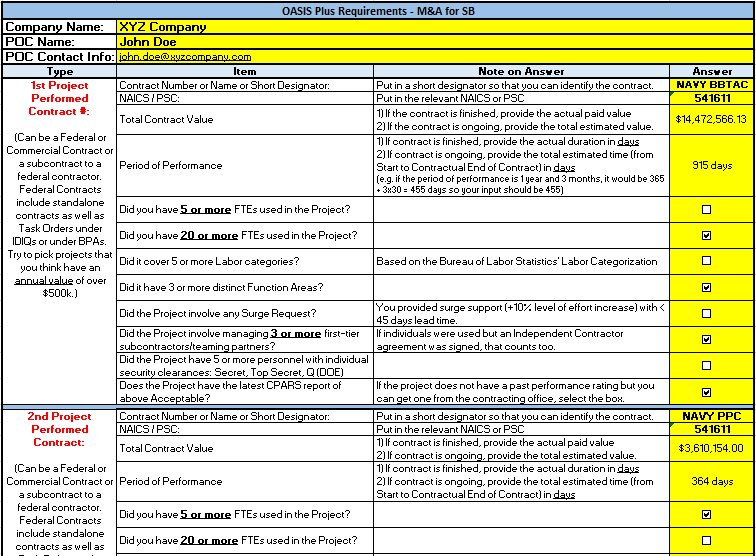
Once you have a list of potentially eligible contracts, the next tool is a contract profiler. This tool should help you capture OASIS Plus-required data points for each contract and map each contract to the applicable scoring factor and sub-factor. This is often implemented in a structured worksheet or form (commonly in Excel).
A practical approach is a questionnaire-style form where, for each contract, the total value, period of performance (PoP), and NAICS/PSC codes are entered. Additional data can then be captured through structured yes/no prompts to streamline profiling.
When building your profiler, ensure the questions and prompts are organized by the scoring factors for the specific domain, because each domain has different requirements.
Tool No. 3 – Contract Score Analyzer
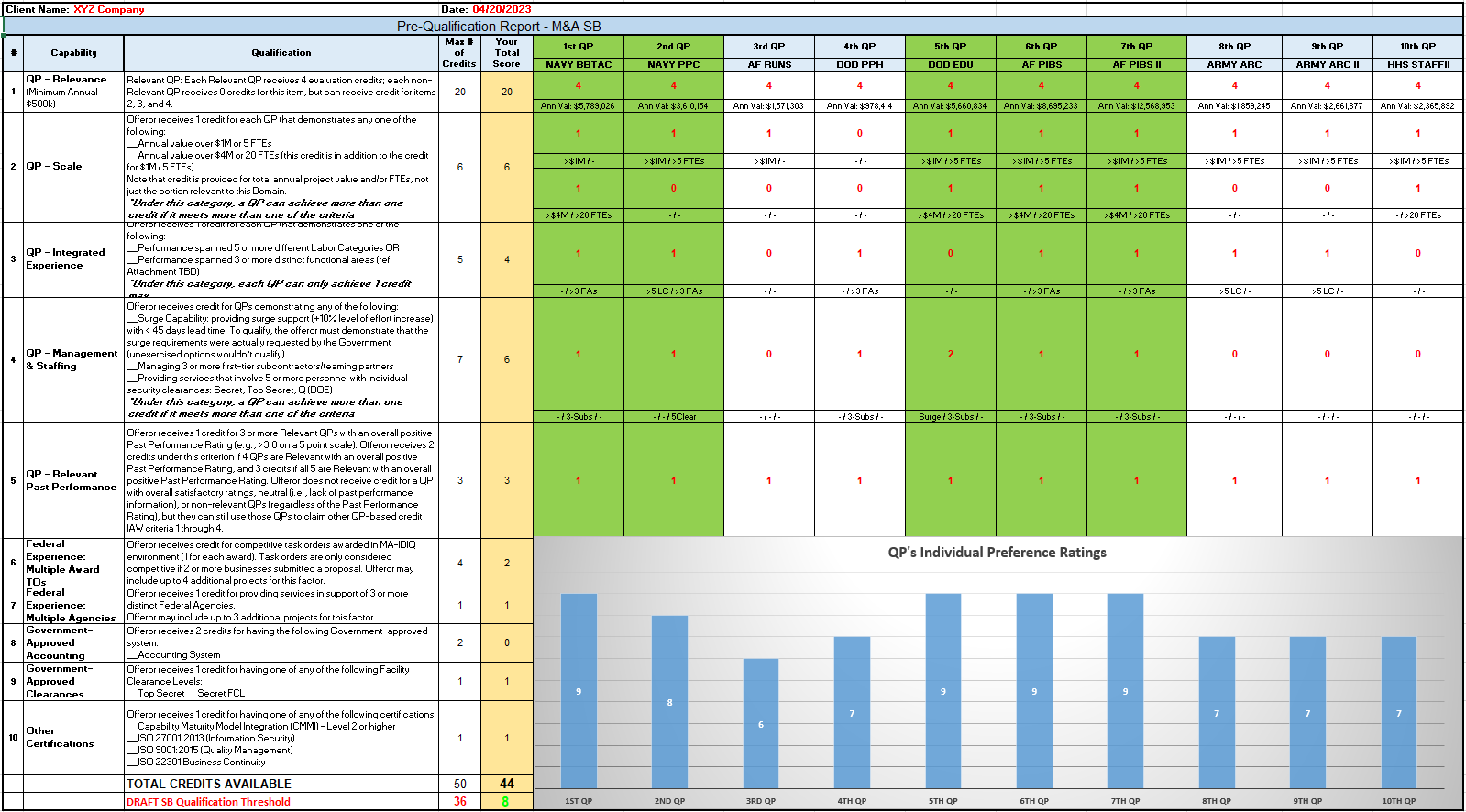
The third tool is a contract score analyzer. OASIS Plus allows you to submit up to five contracts for scoring under certain sections—so if you have more than five strong candidates, you need a method to select the best mix. The highest-value contracts are not always the best-scoring contracts. In many cases, a lower-value contract can score higher because it earns points in other sub-factors.
A score analyzer helps you score each contract independently, compare totals, and identify the five contracts that produce the strongest overall score when all sub-factors are considered. Some teams automate this selection using formulas or scripts; others do it manually by comparing scored worksheets—either approach can work if it is disciplined and repeatable.
If you are pursuing multiple domains, you should develop a domain-specific scoring analyzer for each domain, because scoring requirements differ across domains.
If Phase 1 is where you’re stuck (domain/track selection, eligible contracts, score optimization): Start With An OASIS Plus Eligibility Assessment
OASIS Plus Tools for Phase 2:
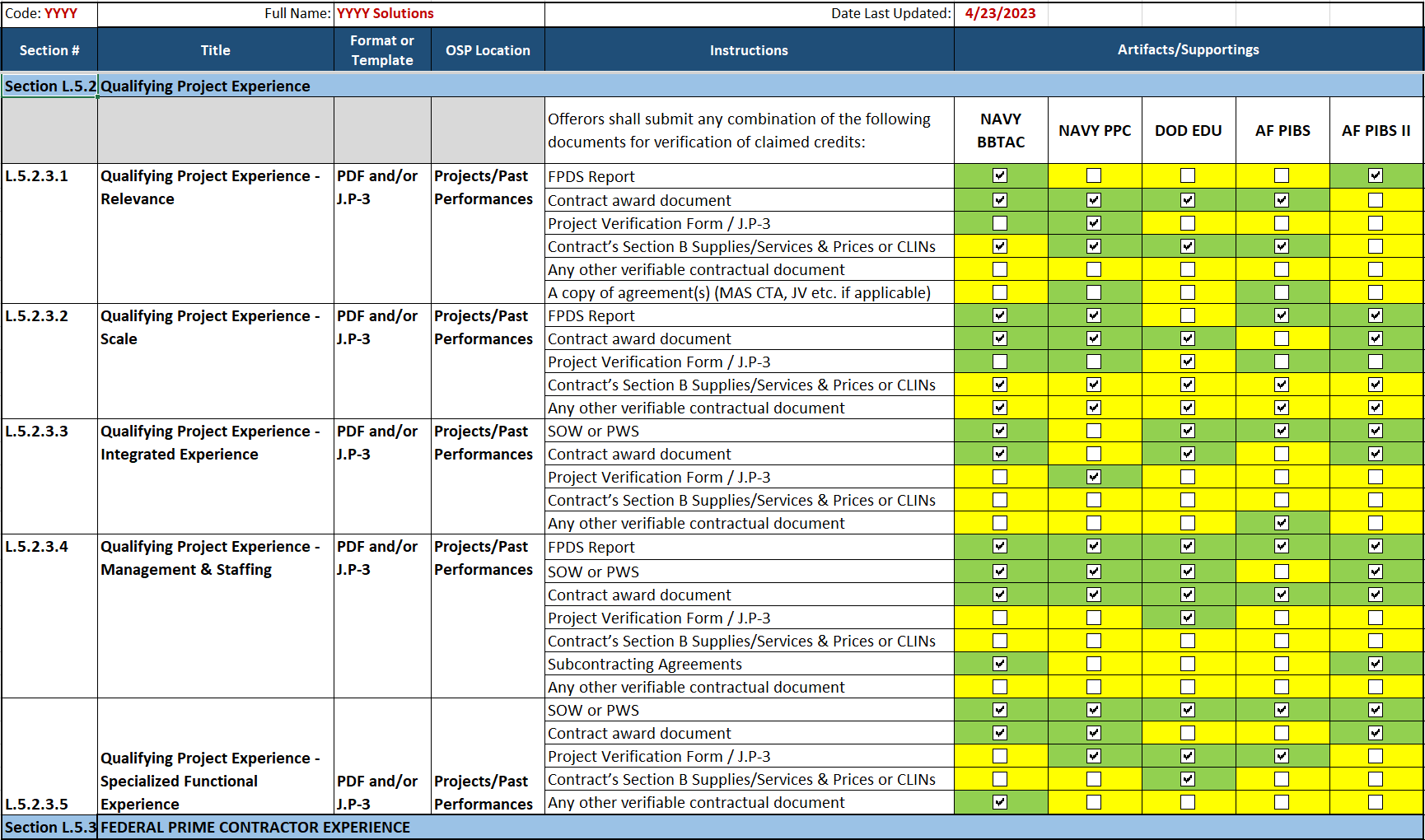
Tool No. 4 – Substantiation Matrix
In Phase 2, you need a tool to assemble the substantiation package. Because the proposal is the contract documentation required to justify the score you claimed in Phase 1, you must know exactly which documents are required to provide full substantiation.
A substantiation matrix lists the documents needed to prove each claimed score point for each contract. Note that this is not the traditional compliance matrix used for narrative proposals. Here, you identify the evidence required for each QP or FEP on a case-by-case basis, aligned to the specific score claims being substantiated.
Tool No. 5 – Compliance Checklist (Build-Stage)
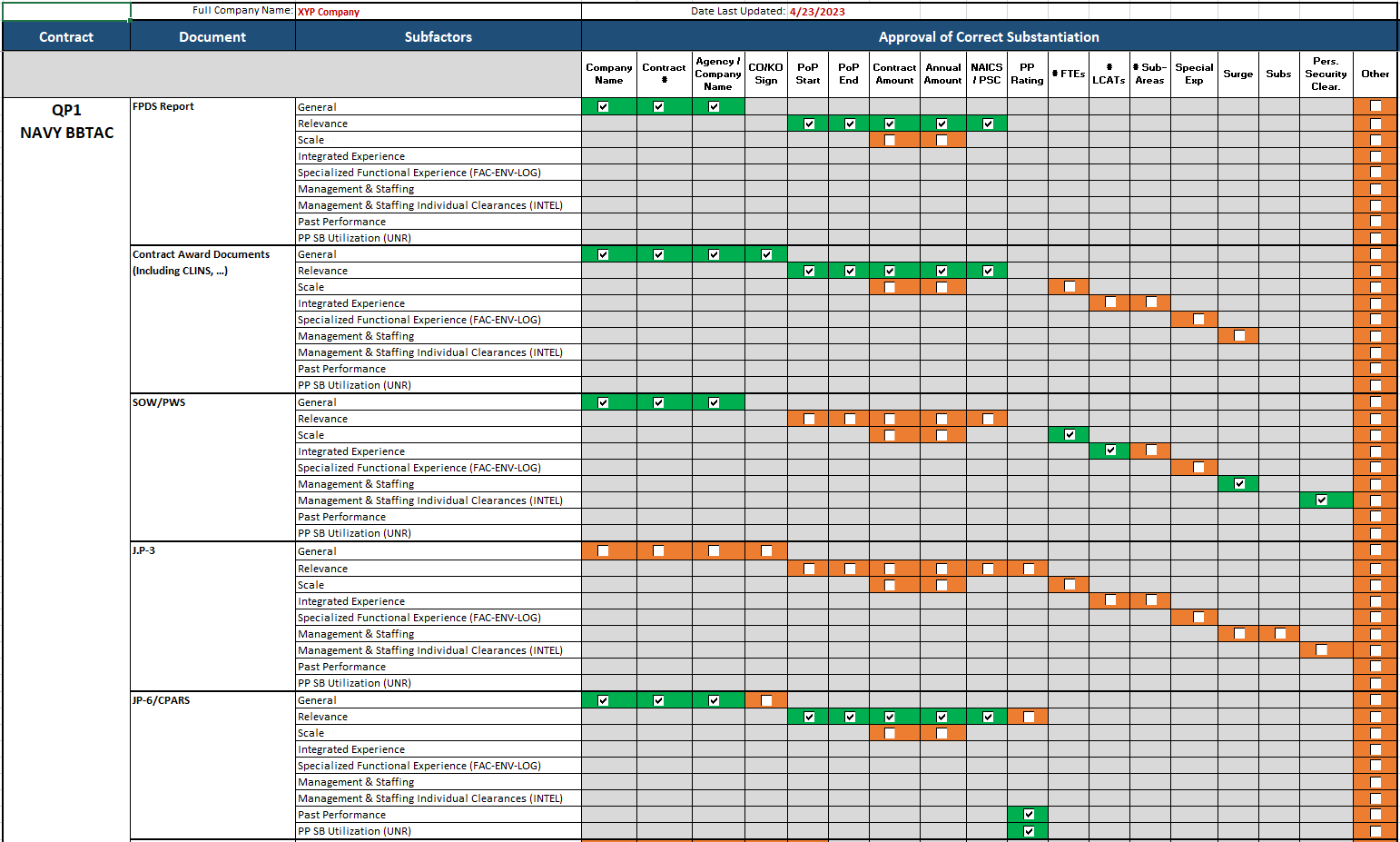
Compliance (in both form and content) is one of the most critical elements of a successful submission. You should prepare a detailed compliance checklist—used in Phase 2 and Phase 3—to verify full compliance with the RFP requirements. This includes formatting, required highlighting, justification presentation, and any tagging required for Symphony submission.
The compliance checklist should cover every section of the submission (QPs, FEPs, Systems and Certifications, administrative documents, and any other required items) in detail. Build it so you can run multiple iterations of compliance checks. A strong practice is at least two rounds of compliance reviews by independent reviewers before submission. Include space for notes so the compliance reviewer can document issues and the proposal team can correct them; then re-check to confirm all fixes are complete.
OASIS Plus Tools for Phase 3:
Tool No. 6 – Compliance Checklist (Final Compliance and Tagging)
The same compliance checklist used in Phase 2 should be used again in Phase 3 for final verification before submission. In this phase, the emphasis is document-by-document verification, tagging readiness, and ensuring each score claim is supported by the uploaded evidence set.
Tool No. 7 – Submission Checklist
You should also create a submission checklist that tracks every document that must be uploaded for each part of the proposal. It should cover each QP, FEP, Systems and Certifications factor, administrative documents, and any additional requirements (for example, financial documents, if applicable).
The checklist should support a post-upload audit to confirm: (1) the correct documents were uploaded to the correct locations, (2) all required administrative documents are present and visible in the Symphony system, and (3) the total score calculated by Symphony aligns with the score you calculated in Phase 1. This becomes even more important if you submit for multiple domains and/or tracks (both SB and UNR).
If you want to validate your scoring position before finalizing uploads: Get An OASIS Plus Eligibility Assessment
Summary:
Successful proposal preparation requires the right tools to perform disciplined contract analysis and maintain strong document control. In this article, we reviewed the OASIS Plus Tools needed across Phase 1 (eligibility and score optimization), Phase 2 (substantiation build), and Phase 3 (final compliance and submission verification). By preparing these OASIS Plus Tools before you begin, you can reduce rework, improve compliance confidence, and strengthen your position for award.
