
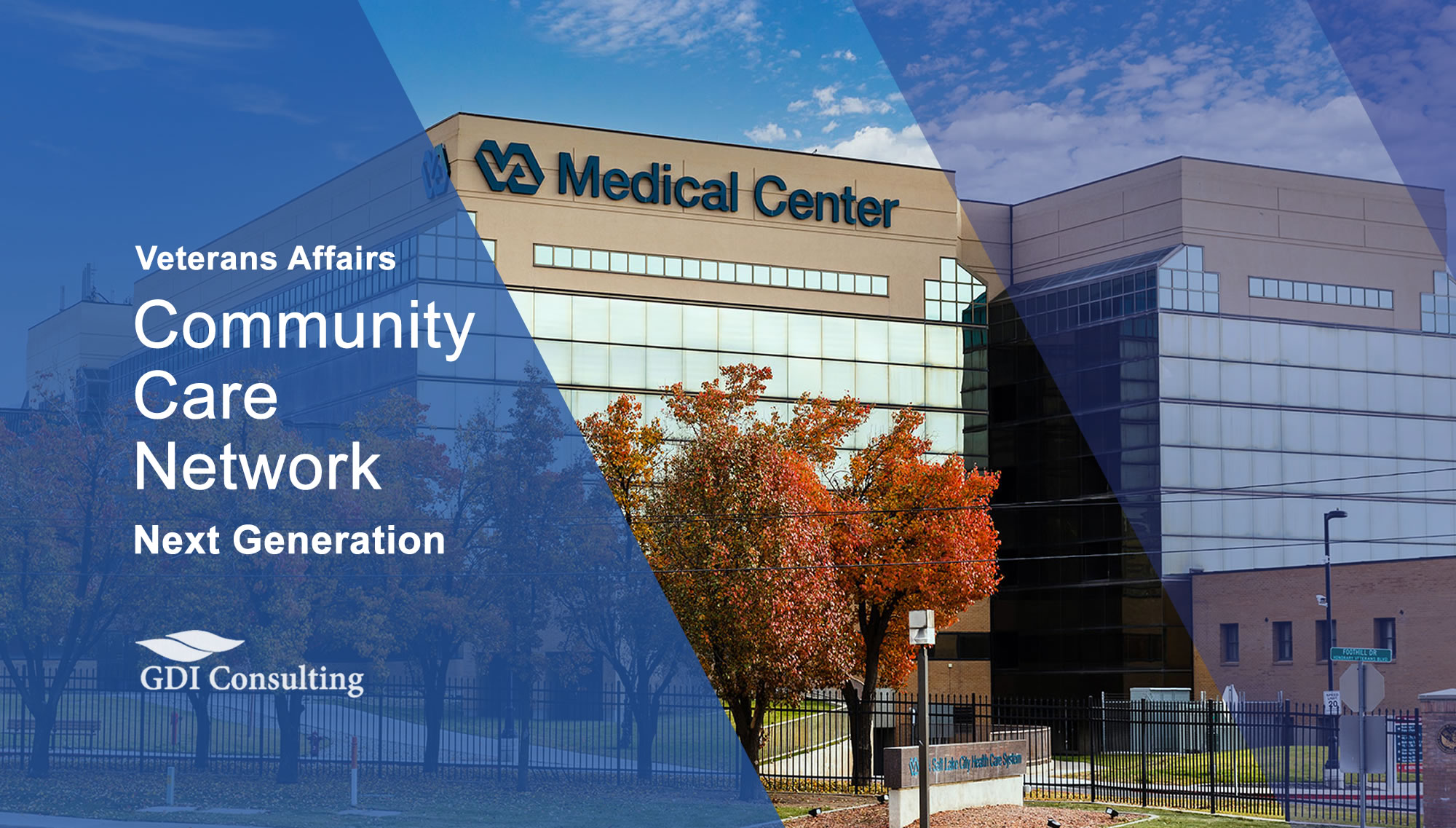
If you're evaluating the CCN Next Gen RFP, the fastest way to avoid misaligned bid effort is to confirm three things early:
(1) your operating model fits the Third-Party Administrator (TPA) responsibilities, (2) your team can support the East and/or West regional execution model, and (3) you can maintain compliance as amendments update Section B/Section E language and task order competition rules.
The CCN Next Gen RFP (Solicitation 36C10G26R0003) is a VA Veterans Health Administration (VHA), Office of Integrated Veteran Care (IVC) requirement for a Community Care Next Generation (CCN-Next Gen) Medical Network in the East and West regions.
The contractor serves as a TPA responsible for regionally managed medical services, customer service, quality outcomes, data/performance metrics,
and claims processing/payment for services ordered against the contract. Proposals are due March 16, 2026 at 2:00 PM ET.
What The Solicitation Is
The Department of Veterans Affairs (VA) — through the Veterans Health Administration (VHA) and its Office of Integrated Veteran Care (IVC) — is seeking support for the Community Care Next Generation (CCN-Next Gen) Medical Network covering the East and West regions. At a high level, this requirement sits in the same continuum of policy and operational change that accelerated with the VA MISSION Act, where VA expanded and refined how Veterans access community providers when VA care is not available or local access is limited. In the background materials provided, the core story is consistent: community care has matured from "getting care outside VA" into a more structured system that emphasizes service expansion and measurable improvements in the Veteran experience— including customer service, accountability, health information exchange, referrals, scheduling, and timely provider payments.
Against that backdrop, CCN Next Gen is positioned as an evolution built on what VA has learned and what it gathered through market research and industry practices. The practical message for offerors is that the CCN Next Gen RFP is not just describing a contract function—it's describing an operating expectation. Your proposal should make it easy for evaluators to see how you will run the TPA mission in a repeatable, measurable way: how you manage regional service delivery, how you monitor and improve performance using data and metrics, how you control quality outcomes, and how you keep claims processing and payment reliable at scale.
Solicitation Snapshot
| Item | What The Documents State |
|---|---|
| Solicitation Number | 36C10G26R0003 |
| Competition Type | Full and Open / Unrestricted |
| Type Of Award | IDIQ – Agency Specific; Multiple expected awards (number unknown) |
| Contract Type | Firm Fixed Price; IDIQ; Task Order |
| Duration / Ordering Period | 10 years (3-year base + 2 + 2 + 2 + 1 option structure) |
| NAICS | 524114 (Direct Health and Medical Insurance Carriers); size standard listed as $47.0M annual receipts |
| Maximum Aggregate Task Order Value | $700,000,000,000 (maximum aggregate value of all task orders under the IDIQ) |
| Proposal Due | March 16, 2026; 2:00 PM ET |
What The Contractor Must Do
The documents define the core requirement clearly: the contractor serves as a Third-Party Administrator (TPA) responsible to provide regionally managed medical services for Veterans referred to community-based medical providers. The contractor must provide exemplary customer service, monitor and manage quality outcomes, use data and performance metrics to improve services, and process and pay claims for services ordered against the contract.
In practical proposal terms, the best way to treat the CCN Next Gen RFP is as a delivery model with measurable outcomes. Even if your organization has strong claims operations, VA's stated emphasis on quality outcomes and performance metrics means your narrative has to show how you actively manage service performance—how you detect issues, how you correct them, and how you report results in a way that supports improved services over time.
Regions And Footprint
The provided documents list the states and territories for the CCN Next Generation West Region and East Region. If your solution is region-specific (or if you intend to emphasize different capabilities by region), your proposal should show how regional execution will work operationally—without forcing VA to infer your staffing model, provider-facing workflows, customer service routing, or claims/payment throughput.
Utah; Washington; Wyoming.
Massachusetts; Michigan; Minnesota; Mississippi; Missouri; Nebraska; New Hampshire; New Jersey; New York; North Carolina; North Dakota; Ohio; Pennsylvania;
Puerto Rico; Rhode Island; South Carolina; South Dakota; Tennessee; Vermont; Virgin Islands; Virginia; West Virginia; Wisconsin.
Ordering Period And What It Means For Your Plan
The documents state the resulting multiple-award IDIQ contracts include a ten-year ordering period with a three-year base period and option periods of two, two, two, and one years. For bidders, the takeaway is straightforward: VA is not looking for a short-term concept. Your approach to customer service, quality outcomes, performance metrics, and claims/payment needs to be credible as a sustained operating model—especially when task order competition and rolling award language are introduced through amendments.
In the CCN Next Gen RFP, this long ordering period is also a planning signal: proposal teams should build a compliance-and-execution story that scales. If your narrative does not clearly show how you keep performance stable as volume changes, evaluators can interpret risk—even if your capabilities are strong.
Timeline Items That Drive Proposal Risk
The timeline information in the provided documents includes multiple amendments and updates tied to specific dates. Several items are especially relevant to proposal planning and compliance control:
- Proposals remain due no later than March 16, 2026 at 2:00 PM ET, and questions were extended to February 4, 2026 at 10:00 AM ET (as reflected in later timeline entries).
- Amendment #6 (January 30, 2026) updated the Table of Contents, updated Section B to add multi-award IDIQ structure and task order competition language, and updated Section E to add rolling award language.
- The government revised acquisition strategy from two single-award IDIQs (Medical East and Medical West) to one multiple-award IDIQ to increase competition and opportunities for qualified vendors.
The operational implication is simple: the more the solicitation changes through amendments, the more likely teams are to miss a requirement unless they maintain a single "source of truth" compliance matrix. If you want to reduce rework, map every key submission instruction and "shall" requirement to your outline before writing, and re-validate after each amendment release.
Mid-Article Next Step
If you're pursuing the CCN Next Gen RFP, a short consultation can prevent wasted effort by confirming whether your team's operating model aligns with the TPA responsibilities (regional medical services administration, customer service, quality outcomes management, data/performance metrics, and claims processing/payment), and by identifying the compliance areas most likely to create rework after amendments.
Bring your current approach (prime/sub model, region focus, and any draft compliance matrix). We'll help you confirm alignment to the solicitation's stated TPA responsibilities and identify the highest-risk compliance items to control early.
Common Proposal Pitfalls On This Type Of Requirement
- Treating Service Delivery As Narrative Only: The requirement explicitly includes quality outcomes management and the use of data/performance metrics. Proposals that do not show measurable operational controls leave the evaluator to assume risk.
- Under-Explaining Claims And Payment Operations: The documents include claims processing and payment as core responsibilities. If your approach does not show end-to-end workflow clarity, it can weaken credibility.
- Not Controlling Amendment Drift: Multiple amendments and Section B/Section E updates are reflected in the timeline. If your internal compliance baseline is not updated after each amendment, teams often miss small but consequential instructions.
- Region Execution Not Made Concrete: The East/West regional construct is explicit. Proposals that don't show how execution
differs (or how it is centrally governed but regionally delivered) can read as generic.
Incumbent Context From The Documents
The provided information also lists current CCN incumbent contracts by region and identifies Optum Public Sector Solutions for Regions 1–3 and TriWest Healthcare Alliance Corp. for Regions 4–5, with contract numbers shown in the documents. This is helpful context for competitive planning and for understanding how the current CCN program is structured as five regional IDIQ contracts covering all U.S. states and territories.
FAQ
When Are Proposals Due For The CCN Next Gen RFP?
What Are The Core Contractor Responsibilities?
What Is The Ordering Period?
Which NAICS Code Is Listed?
Next Step
If you want to pursue the CCN Next Gen RFP with confidence, the most efficient move is to validate fit and compliance early—before you invest heavily in writing. A short consultation can help you confirm alignment to the TPA responsibilities, decide how to present East/West execution clearly, and lock a compliance baseline that stays current across amendments.
