
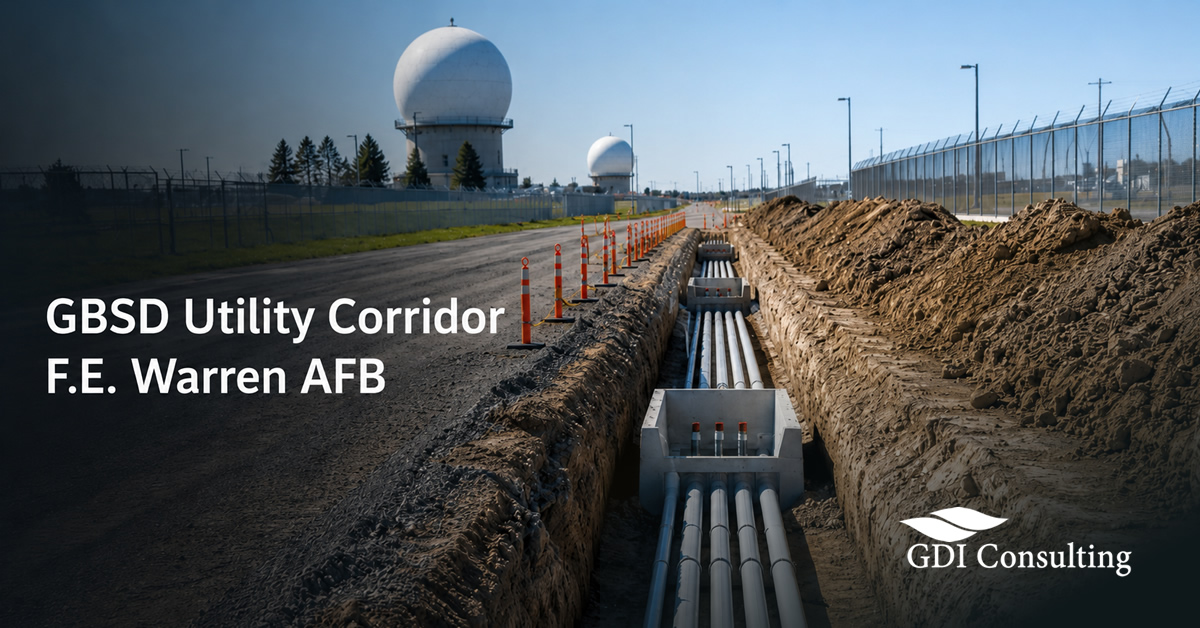
If your team is evaluating the GBSD Utility Corridor at F.E. Warren AFB, the first question is not whether the project is large enough to justify attention. The more important question is whether your firm has the right evidence, delivery role, compliance readiness, field capacity, and proposal bandwidth to pursue it responsibly.
The GBSD Utility Corridor solicitation (W9128F26RA017) is a U.S. Army Corps of Engineers, Omaha District opportunity for utility corridor infrastructure tied to the Sentinel Program at F.E. Warren AFB. For heavy civil, utility, electrical, telecom, and site contractors, the practical decision is whether to lead, team, subcontract, or hold resources for a better-aligned pursuit.
What The Solicitation Is
The GBSD Utility Corridor opportunity is a major federal infrastructure pursuit associated with F.E. Warren AFB and the Sentinel Program. The solicitation package describes a two-phase Design-Build / Design-Bid-Build multiple-award task order contract structure for construction services. The work is not a routine site utility package. It points to long-route corridor execution, underground utility infrastructure, telecommunications-related work, and task-order delivery across a broader geographic footprint.
That combination can be attractive to heavy civil and utility contractors, but it also raises the threshold for a credible pursuit. The opportunity should be reviewed through evidence, capacity, compliance, and execution risk rather than size alone.
Why This Opportunity Deserves Careful Review
Large federal utility and infrastructure projects require more than a general capability match. A contractor may have strong utility crews, relevant equipment, and federal construction experience but still lack the documented past performance, secure-document readiness, bonding capacity, partner coverage, or proposal resources needed for a competitive lead role.
The review should happen early. Contractors should assess whether the opportunity fits their route, timing, field execution capacity, compliance requirements, and likely role before key personnel are deep into estimating, scheduling, teaming, technical writing, and pricing.
Solicitation Snapshot
| Item | What The Solicitation Documents State |
|---|---|
| Solicitation | GBSD Utility Corridor / GBSD UC at F.E. Warren AFB, WY |
| Solicitation Number | W9128F26RA017 |
| Agency / Issuing Office | U.S. Army Corps of Engineers, Omaha District; W071 ENDIST Omaha, KO Contracting Office |
| Location / Place Of Performance | F.E. Warren AFB, Wyoming, with utility corridor limits extending across southeast Wyoming and into portions of northeast Colorado and western Nebraska |
| NAICS | 237130 – Power and Communication Line and Related Structures Construction |
| Competition Type | Unrestricted / Full and Open Competition |
| Estimated Value / Magnitude | Shared MATOC capacity up to $1.7 billion; up to five firms; firm-fixed-price task orders |
| Response Date | Phase One proposals extended to June 17, 2026 at 2:00 PM CDT |
| Scope Summary | Design and construction for the F.E. Warren Utility Corridor, including utility corridor infrastructure and telecommunications-related work issued through task orders |
What The Work Appears To Include
The documents point to utility corridor work with major underground and communications-related elements. Contractors should verify the final scope against the current solicitation package, but the pursuit appears relevant to firms with experience in trenching, conduits, communication lines, pull vaults, manholes, boring under roads, rivers, and railways, site restoration, and long-route utility corridor execution.
This scope profile matters because a contractor with general sitework experience may not have enough directly relevant evidence for a lead role. The issue is not whether the firm can perform some work. It is whether the firm can prove recent, relevant, comparable work at the scale and complexity the solicitation is likely to reward.
Past Performance Should Drive The Role Decision
The Phase One evaluation places substantial weight on past performance. Offerors are asked to provide project examples, including design-build experience, construction performance, and work by the lead design entity as designer of record. The most relevant project summaries should emphasize construction services involving underground utilities, with telecommunications-related scope where applicable.
Contractors should compare their record against the likely evaluation themes: project size, complexity, utility scope, design/construction coordination, geographic and climate relevance, federal performance expectations, and contract complexity. A firm may be operationally capable but still weak on evidence. If the record is thin, outdated, narrow, or difficult to document, a team or subcontract role may be more realistic than leading the pursuit.
Bonding, Staffing, Equipment, And Field Capacity
The solicitation requires bonding information as part of the pursuit picture, including a bonding company letter addressing current maximum bonding capacity per project and aggregate capacity. Performance and payment bonds are also tied to individual task orders. Contractors should treat bonding as an early screen, not an administrative item to resolve later.
Field capacity should be reviewed with the same discipline. A credible pursuit needs realistic access to supervisory staff, equipment, crews, subcontractors, safety systems, quality control resources, design partners, and corridor execution management. If those resources are already committed elsewhere, the proposal may be stronger than the firm can support in performance.
Security, Access, And Federal Compliance Risk
This opportunity includes controlled-document and information-handling issues that can affect both proposal preparation and performance. The documents reference Controlled Unclassified Information, SAM and PIEE requirements, SPRS confidence-level requirements, and CMMC Level 2 Certified Third-Party Assessment Organization requirements for contractor information systems that process, store, or transmit FCI or CUI during performance.
Contractors should not assume these requirements are only the lead contractor’s concern. Key subcontractors, design entities, proposal systems, file-sharing practices, and performance data workflows may need to be reviewed before a team commits to the pursuit.
Clarify The Pursuit Path Before Proposal Work Expands
For many contractors, the most useful near-term decision is the role decision. A firm may be positioned to lead the pursuit, support a stronger team, pursue a defined subcontract scope, or hold resources for opportunities with a clearer match. That decision should be based on the solicitation requirements and the firm’s actual evidence, not only on interest in the program.
Bring the solicitation name and number, due date, intended role, relevant past performance, bonding position, known capacity constraints, and any compliance or teaming concerns. GDIC can help your team frame the practical pursuit decision before proposal work becomes more resource-intensive.
Lead, Team, Subcontract, Or Hold?
A disciplined review should lead to a clear role decision. The right answer will not be the same for every contractor.
| Path | When It May Make Sense |
|---|---|
| Lead | The firm has direct, recent, relevant underground utility and telecommunications infrastructure experience; credible DB/DBB capability; adequate bonding; strong safety, quality, and program management systems; and enough proposal capacity to compete seriously. |
| Team | The firm has meaningful capability but needs a stronger lead, complementary design partner, secure-facility experience, broader geographic reach, or additional program management depth. |
| Subcontract | The firm fits a defined work package, such as boring, trenching, conduit installation, communications, electrical, restoration, inspection, traffic control, quality control support, or local field execution. |
| Hold | The pursuit would absorb executive, estimating, compliance, pricing, operations, and proposal resources that are better used on a more winnable or better-aligned opportunity. |
Proposal-Resource Reality
Mega-project pursuits can consume substantial internal bandwidth before there is any award certainty. The GBSD Utility Corridor pursuit may require past performance selection, teaming documentation, bonding evidence, program management narrative, design capability discussion, technical approach development, risk review, compliance checks, and later pricing and seed-project response work for selected offerors.
That burden matters because proposal resources are finite. A construction firm may be capable of performing parts of the work but still make a poor pursuit decision if the proposal effort displaces bids with stronger win probability, clearer fit, or faster revenue timing.
The decision should happen before the team is fully inside proposal production. Waiting until gaps appear halfway through the response process can turn a strategic decision into a sunk-cost problem.
What To Have Ready For An Opportunity Review
An early review is more useful when the contractor has the basic decision inputs ready. For the GBSD Utility Corridor, that should include:
- Solicitation name and number: GBSD Utility Corridor / W9128F26RA017.
- Current due date and proposal phase being reviewed.
- Intended role: lead, team member, subcontractor, or undecided.
- Relevant past performance in underground utilities, telecommunications infrastructure, long-route construction, federal facility work, DB/DBB delivery, northern-climate work, or task-order execution.
- Bonding capacity and any known constraints.
- Internal staffing, equipment, scheduling, and estimating limitations.
- Key subcontractor gaps or teaming needs.
- Compliance concerns involving CMMC, CUI, SAM, PIEE, SPRS, or secure information handling.
- Whether assistance may be needed for proposal strategy, compliance review, teaming, subcontractor positioning, or final proposal production.
Conclusion
The GBSD Utility Corridor at F.E. Warren AFB is a significant federal infrastructure opportunity, but significance alone does not make it the right pursuit for every contractor. Firms should evaluate the solicitation against their actual evidence, resources, compliance readiness, and delivery position before committing proposal bandwidth.
For some firms, this may be a credible opportunity to lead. For others, the better route may be teaming or subcontracting. For firms without the right past performance, bonding, proposal capacity, or compliance readiness, holding resources for a better-aligned opportunity may be the more disciplined choice.
If your team is reviewing the GBSD Utility Corridor opportunity — or another federal solicitation already on your table — GDIC can help you assess the practical next step before proposal resources are fully committed.
