
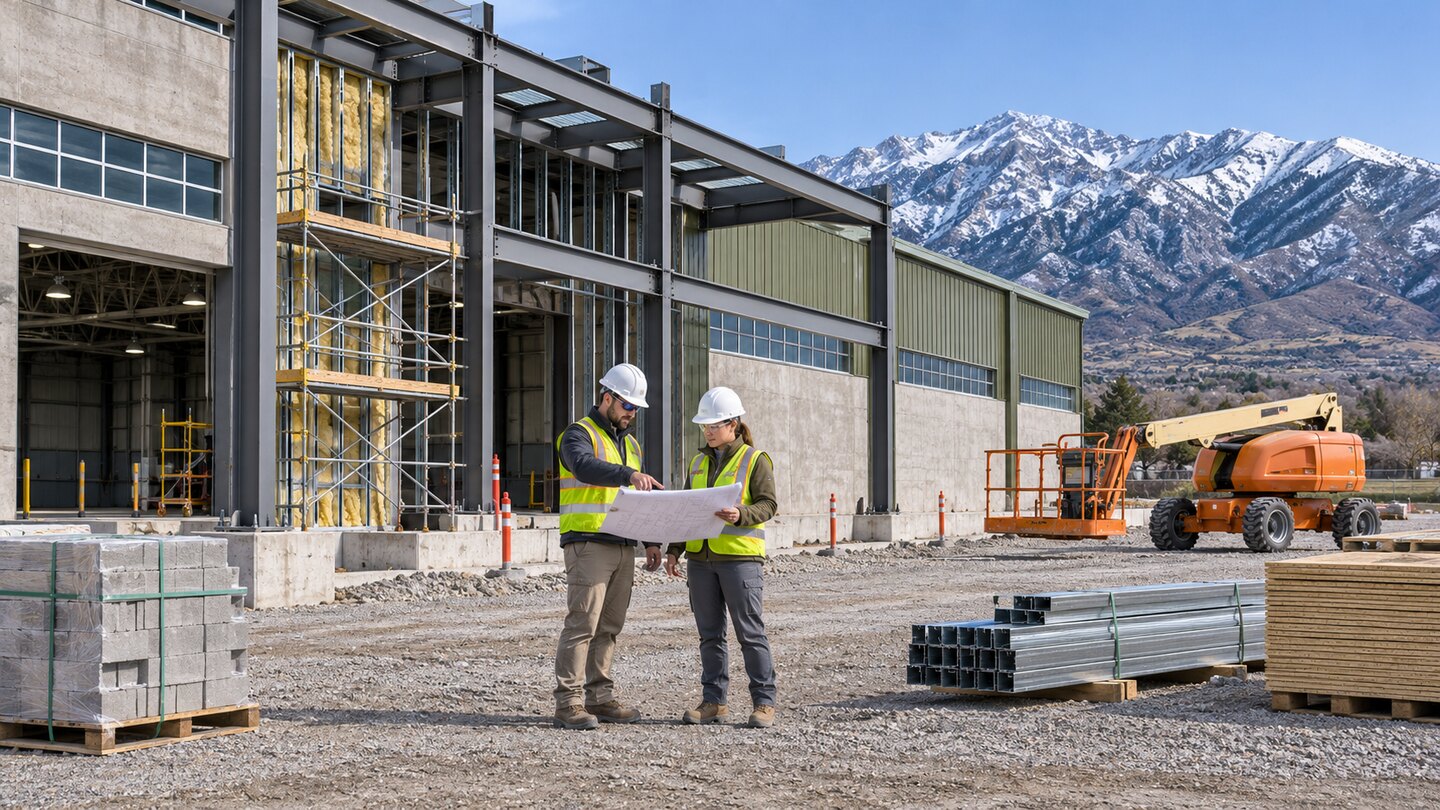
The Air Force’s Hill AFB Multiple Award Construction Contract V is a $650 million shared-ceiling vehicle for small-business construction primes under NAICS 236220. Solicitation FA820126R0016 covers work at Hill and other locations in Utah and Wyoming. The Air Force is targeting eight to ten base awards, but only one awardee will receive the Building 509 seed task order. The immediate decision is whether your firm can clear the local-office gate, put forward a credible Building 509 proposal, and submit ceiling rates it can live with after award. Air Force solicitation, Section B and Sections L/M
Deadline alert: The solicitation form and Section L say December 9, 2026, at 4:30 p.m. local Mountain time. The portal’s 4:30 p.m. MDT (UTC−6) entry converts to 3:30 p.m. MST in Utah on December 9, consistent with the SAM display. Until the Air Force clarifies the mismatch, plan to submit before the earlier time and verify the latest posting before upload. SAM.gov notice · PIEE solicitation and amendments
First gate: A real local office, not a future plan
This is a total small-business set-aside with a separate geographic pass/fail gate. The prime must be located within 100 miles of Hill AFB, or have an approved, operational bona fide office within that radius at proposal submission. A plan to open an office after award does not meet the stated timing. Check the proof required by Attachment 37 before committing proposal resources. If the prime cannot document eligibility, consider supporting an eligible bidder instead. Section L §7.3.3; Section M geographic compliance; Attachment 37
Two more checks belong on the first day. Section L calls for a current CMMC Level 1 record in SPRS for the performing business segment and CAGE code at submission; Section M describes verification at award. Plan for the earlier requirement and maintain the status. Also confirm the surety will issue the required prequalification letter: Tier 1 is $5M single and $20M aggregate; Tier 2 is $20M single and $80M aggregate. Those thresholds are distinct from the seed bid guarantee. Confirm that your available bonding covers the actual Building 509 price and your existing backlog. Sections L/M, contractor requirements and contract documentation
Two prices, two decisions
The Air Force ranks base offers by total evaluated price, calculated from proposed rates and undisclosed notional hours. Evaluation starts with the lowest-ranked offer. A higher-priced offer might never reach technical review if enough lower-priced offers are acceptable. Conversely, a low price will not offset a failed technical subfactor. The rate worksheet is for evaluation, but the proposed ceiling rates become binding. Build rates that cover real labor, oversight, overhead and escalation; a rate that helps you enter the MACC can hurt you on every order you pursue later. Sections L/M, Volume I
Building 509 is priced separately. Its firm-fixed price is not part of the base ranking formula. The seed goes to the MACC awardee with the lowest evaluated, technically acceptable seed price. Each base awardee’s $2,500 minimum guarantee is satisfied through an administrative task order tied to the post-award conference. It is not an allocation of construction work. Section M, seed pricing and minimum guarantee
Building 509 is the proposal workload to price first
The amended seed request identifies a $5M–$10M project, 730 calendar days from notice to proceed, a 20% bid guarantee, and a critical-path schedule that accounts for typical Hill AFB weather delays. The base technical volume also calls for seed-specific accident prevention and quality-control plans, a design narrative, concept drawings and preliminary calculations. Read both packages together. Do not treat the seed as a pricing worksheet that can be delegated to estimating at the end. Section L, Volume II; Section M, technical subfactors; Attachment 41, §§II–IV
Get the design partner’s commitment in writing, then check its evidence: the solicitation calls for a recent project designed by that partner and certified LEED Silver or higher, comparable design and construction projects, and a plan to obtain qualified fire-protection engineering services. Separately, screen the prime’s design-build record against the technical requirements. Where the wording in Sections L and M differs on the $2M project threshold, build to the stricter reading in Section L: three projects of at least $2M each, including one over $5M, unless the Air Force clarifies otherwise. Sections L/M, Technical Subfactors 2 and 3
Submission and the bid/no-bid call
Build the four base volumes in parallel: Price, Technical, Past Performance, and Contract Documentation. Use the format and component limits in Section L, include the editable pricing workbook and the technical cross-reference matrix, and verify the PIEE receipt. The seed attachment contains separate submission language; reconcile it with the base instructions and latest amendment rather than assuming an email can substitute for the main PIEE submission. Section L, Table 1 and Appendix II; Attachment 41
GDI’s take: Bid as prime if the local-office proof, surety, experienced design team, and seed estimate are already within reach. If the office test fails, team or pass. If the office qualifies but your designer or estimator cannot produce the Building 509 package within the remaining time, pass rather than count on a cure after submission. For firms that do bid, test the economics beyond Hill itself: can you staff and supervise simultaneous orders at dispersed sites without stretching the same people and trades across every job? That is what turns a spot on the MACC into work you can deliver profitably. GDI Consulting construction proposal services.
