
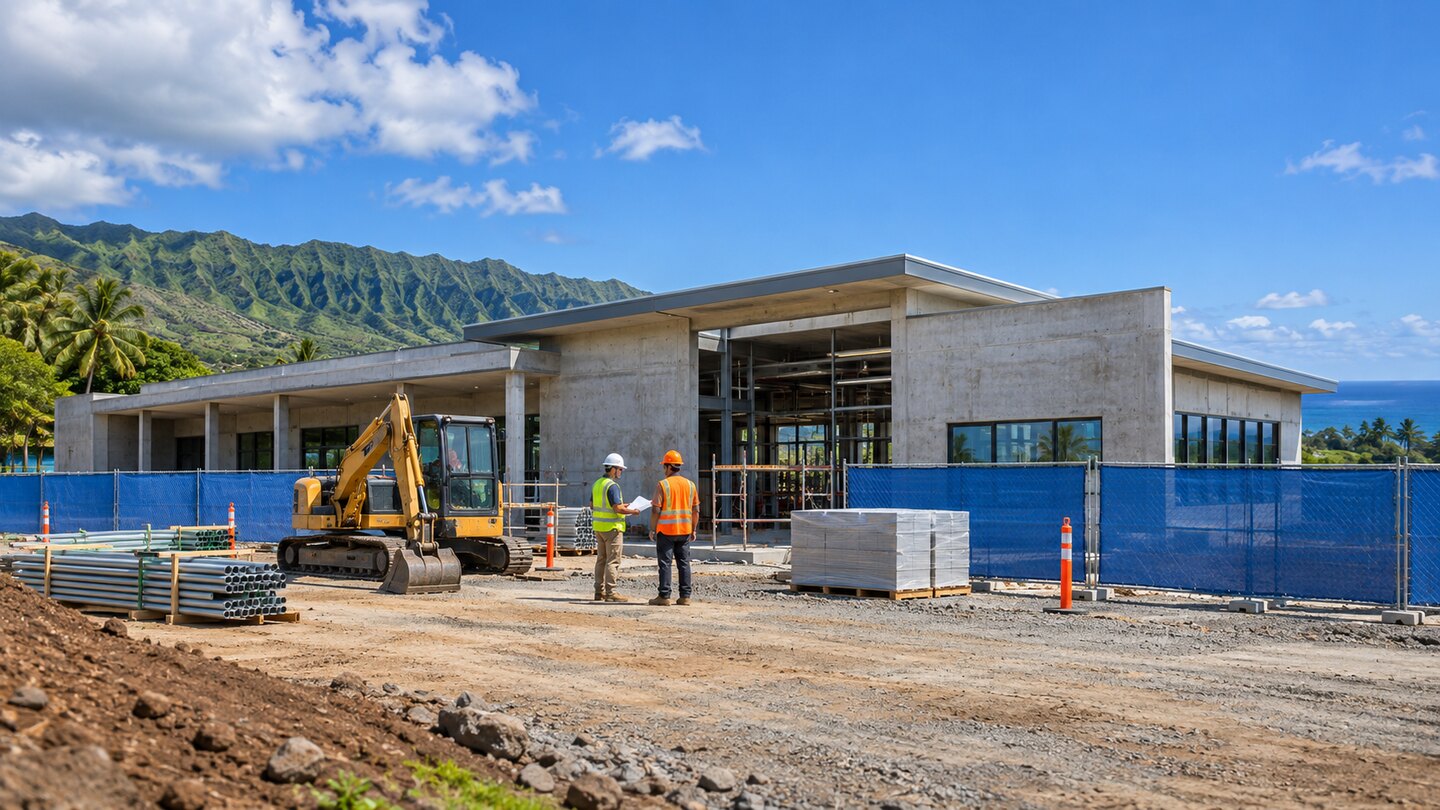
The U.S. Army Corps of Engineers, Honolulu District, is seeking small-business contractors for design-build and design-bid-build construction across Hawaiʻi. Solicitation W9128A26RA007 is a total small-business set-aside under NAICS 236220. The official SAM.gov notice lists Phase 1 proposals due January 8, 2027, at 2:00 p.m. Hawaiʻi Standard Time.
Deadline discrepancy: Amendment 0001’s SF 30 continuation page prints January 8, 2026 for proposals and October 30, 2025 for questions. The original SF 1442, the slides added by that amendment, and the current SAM.gov offer date point to January 8, 2027 for proposals. The base instructions and amended slides show October 30, 2026 for questions. Before submitting, check the latest official PIEE package for any formal clarification or later amendment.
The first bid/no-bid test: Can your company document at least three relevant construction projects above $10 million each, including a design-build project, and obtain a surety letter for $10 million single and $50 million aggregate bonding? Then ask whether your proposed designer has the evidence to support its own portfolio and whether your management team can explain how it will run concurrent work in Hawaiʻi. These are the questions to answer before committing proposal resources. PIEE solicitation, Section 00 22 10, §§4–6
Scope and business opportunity
The vehicle covers new construction, repair and renovation, including both building and civil infrastructure work. It has a five-year base ordering period with a possible six-month extension. The solicitation describes firm-fixed-price task orders ranging from $2,000 to $35 million, with fair-opportunity competition for orders above $2,000 unless an exception applies. The $495 million is shared capacity across the vehicle, not an award amount for each contractor. Build the business case around the jobs your team could realistically staff, bond, and win. PIEE solicitation, Sections 00 10 00 and 00 22 10, §1
How the Corps will select contractors
Phase 1 is a competitive qualifications screen with no price proposal. Past performance is the most important factor, organization and management is second, and bonding is go/no-go. USACE targets five to seven firms for Phase 2, not five to seven guaranteed awards. It intends to shortlist on initial submissions without discussions, so bidders should not count on an opportunity to repair missing evidence. Section 00 22 10, §§2 and 3.4
Only shortlisted firms receive the Phase 2 amendment and compete on the seed project. The Corps intends to award a base contract to each responsible Phase 2 offeror that is at least acceptable on every technical factor and offers a fair and reasonable seed price. The seed task order itself goes to the best-value offeror. For that tradeoff, the construction narrative and drawings matter more than the schedule; together, those technical factors are approximately equal to price. Phase 1 ratings do not carry into that tradeoff. Section 00 22 10, §§2.3 and 3.5
Past performance: Build two portfolios, not one project list
The prime’s construction portfolio calls for three to five projects, including at least one design-build project. Each must exceed $10 million after modifications, be similar in scope, and meet the solicitation’s recency test: at least 80% complete or turned over within the specified seven-year window, with the required completion evidence or CPARS. The Corps looks for both vertical and horizontal construction across the portfolio. A master IDIQ is not a project reference; use a qualifying individual task order or stand-alone contract.
Build the design portfolio with the proposed prime designer, using three to five relevant design projects. The design references have a separate $10 million or more estimated construction cost threshold. A design-build project can support both portfolios if it meets both sets of criteria and you submit the appropriate forms. Record the actual role and effort of each proposed entity rather than taking credit for the entire team’s work. The Corps considers Hawaiʻi location in judging relevance and may give more weight to repeat relationships with Hawaiʻi subcontractors. Those are evaluation considerations; don’t substitute them for the stated project minimums. Use CPARS or the solicitation’s past-performance questionnaire as appropriate, and make sure the design evidence addresses the quality of design services. Section 00 22 10, §§4.1–4.4, Attachments 2–5
Management and bonding: Show how the work gets done
The management plan should explain who leads each job, who can make decisions, and how the prime and designer share responsibility on design-build and design-bid-build work. Use the organization chart to show how you would handle two orders at the same location and two at different locations. Get signed commitments from listed key subcontractors, including the prime consultant as applicable. A named partner without a signed commitment can hurt the rating. Section 00 22 10, §5
The Corps explicitly evaluates shipping contingencies, experience managing projects in Hawaiʻi, and the ability to staff remote work with skilled labor. Give evaluators a credible plan: name the person who owns freight and procurement, identify backup suppliers and trades, and show how you would resequence work after a missed sailing. The Corps’ conference briefing cites a supplier example of 26–30 weeks for coated ductile iron pipe and fittings, including ocean freight. That is an example to stress-test a schedule, not a universal lead time. Section 00 22 10, §5.2; Amendment 0001 conference slides, slide 30
Get the signed bonding letter before writing the management plan. Then run a separate delivery check with your surety: how much capacity would remain if you were carrying your current backlog and two additional orders? The minimum letter gets you through the evaluation gate; available capacity determines which orders you could actually take on. Section 00 22 10, §6
Submission and pursuit decision
Phase 1 calls for an administrative file and three factor files through PIEE. Use the solicitation’s filenames, searchable PDFs and bookmarks. Check the separate limits: 10 pages each for construction and design project narratives, four pages for the past-performance matrix, and 10 pages for the management plan. These are component limits, not one overall proposal cap. Leave time to verify PIEE access, amendment acknowledgments, and upload receipt. Section 00 22 10, §§1.5, 3.1–3.4, 4.2–4.4 and 5.1
GDI’s take: Pursue if you can prove the project thresholds, secure the required bond letter, and put a credible Hawaiʻi management team on paper. If you’re missing one of those, resolve it before spending heavily on the proposal. A firm with strong trade capabilities but no qualifying prime portfolio may get more value by teaming with a qualified bidder. For a go/no-go review or help mapping your references to the evaluation criteria, see GDI Consulting’s construction capture and proposal services.
