
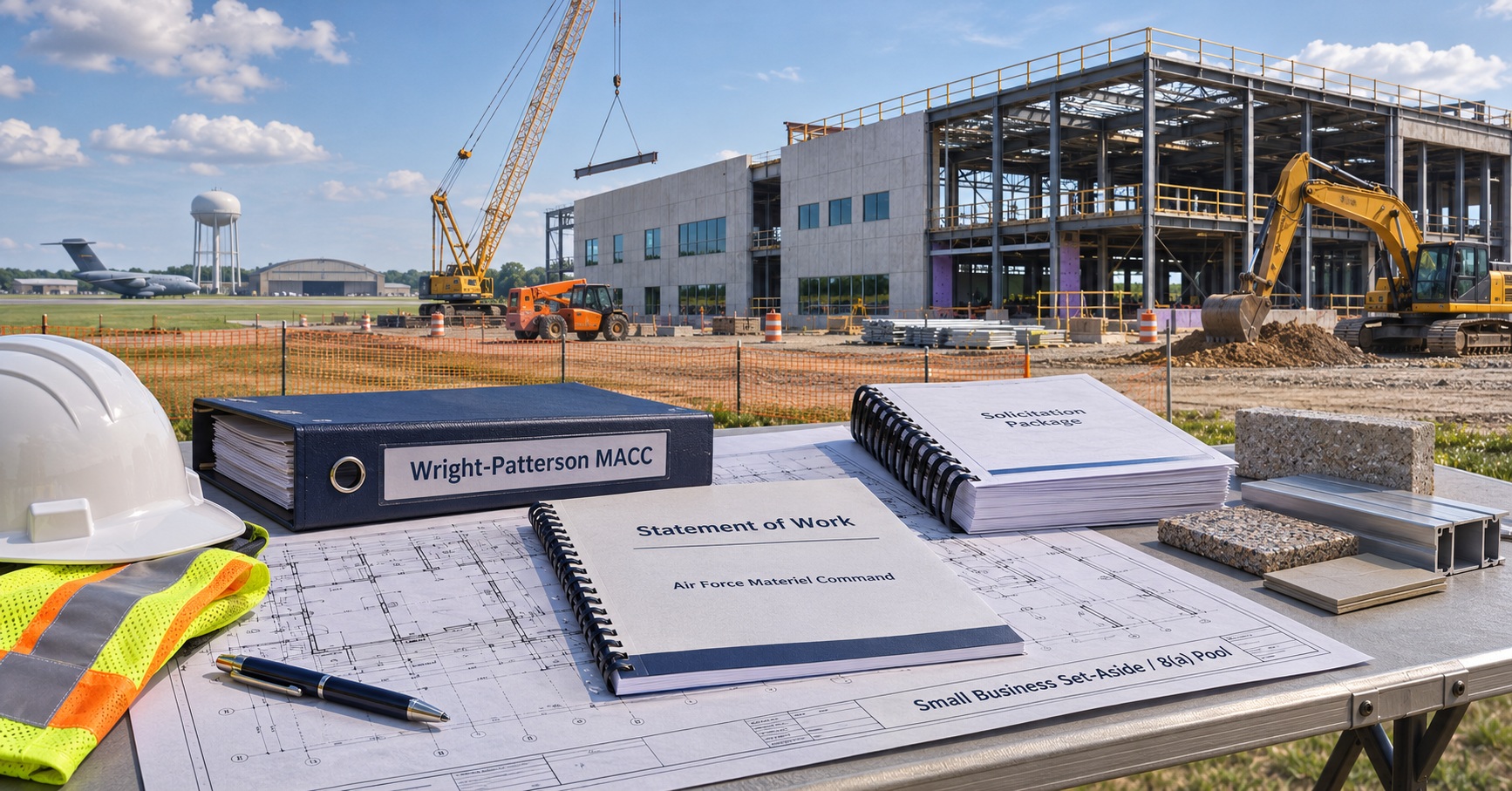
The Wright-Patterson MACC is a $450 million Air Force multiple-award construction opportunity at Wright-Patterson Air Force Base, Ohio. Solicitation FA8601-27-R-0004 seeks qualified small businesses to manage construction, repairs, renovation, and design services through an indefinite-delivery/indefinite-quantity (IDIQ) contract. Proposals are currently due December 11, 2026. Amendment 0001, issued November 9, changes several controlling attachments, so offerors should base their submissions on the current government solicitation and monitor subsequent changes.
Scope and Business Opportunity
The 88th Air Base Wing Civil Engineer Group needs contractors able to execute multiple concurrent projects across a diverse installation. Requirements may include new buildings, additions, renovations, utilities, roofs, road and airfield-related improvements, alterations, building repairs, and hazardous-material remediation. Individual task orders will establish the actual project scope and delivery requirements. The MACC accommodates design-build, design-bid-build, and progressive design-build approaches, depending on the work ordered.
Wright-Patterson houses operational, research, industrial, administrative, medical, secure, and airfield facilities. A construction contractor could encounter occupied spaces, complex utility interfaces, controlled site access, specialty trades, or work requiring careful sequencing. These are execution considerations rather than extra published evaluation factors. The practical question is whether a firm has dependable personnel, design partners, project controls, and subcontractor management practices to support more than one kind of construction assignment.
The Wright-Patterson MACC’s $450 million ceiling is aggregate, not a promise of revenue to each awardee. Section L identifies a $2,500 minimum obligation for the basic contract, with separately funded task orders for actual projects. Contractors must account for the cost of qualifying for the IDIQ and the continuing effort needed to compete for task orders. A base contract provides market access rather than an assured backlog.
Key Solicitation Facts
| Item | Current Information |
|---|---|
| Agency | U.S. Air Force; Wright-Patterson AFB, Ohio |
| Solicitation | FA8601-27-R-0004; Amendment 0001 on November 9, 2026 |
| Vehicle | Multiple-award firm-fixed-price IDIQ; $450 million shared ceiling |
| Competition | Small-business pool and 8(a) pool; NAICS 236220 |
| Deadline | December 11, 2026, subject to government amendments |
How the Air Force Will Select Contractors
Revised Section M establishes a technically acceptable source-selection process. The government intends to award a basic IDIQ contract to each responsible offeror satisfying the mandatory requirements, while retaining discretion to make fewer awards or none. Awardees are then divided between an 8(a) pool and a general small-business pool. A firm must verify its eligibility for the applicable pool as well as its technical competence.
A critical feature of the Wright-Patterson MACC is that price is not an evaluation factor for the base IDIQ award. Price becomes relevant in subsequent task-order competitions using a lowest-price, technically acceptable approach. This creates two distinct challenges: prove technical and financial acceptability to enter the vehicle, then compete on project pricing and performance when actual construction requirements emerge.
The government’s technical evaluation is pass/fail. Four subfactors cover management and quality plans, prior experience, execution of the sample project, and bonding. One unacceptable subfactor makes the overall technical evaluation unacceptable. An otherwise impressive record does not offset missing bonding evidence or an inadequate quality-control approach. Section L compliance is also examined, and incomplete or nonresponsive proposals may be removed before the substantive review.
The Air Force intends to award without discussions, although it reserves the right to conduct them. Offerors should treat their initial proposals as fully evaluated submissions, not starting points for negotiation. A disciplined compliance matrix, independent document review, and careful version control over amendments are more reliable than hoping to repair a missing requirement after submission.
Construction Experience: A Strict Eligibility Test
Section L requires three to five construction or renovation projects valued above $1 million each. The projects must have been completed within five years or be ongoing and at least 75% complete. The offeror must have acted as prime contractor and self-performed at least 7% of the work. These are explicit conditions, so subcontracting experience or an IDIQ award without qualifying individual project execution should not be presented as equivalent.
Collectively, the references must demonstrate a design-build project managed by the prime under one firm-fixed-price contract, at least one project exceeding $5 million, concurrent project management, new construction or an addition, renovation, and work in an occupied facility. One project may satisfy multiple criteria. The RFP also lists examples of complex work such as laboratories, secure buildings, fire protection, airfields, and administrative facilities without requiring every category.
For the Wright-Patterson MACC, build a project-by-project verification matrix before deciding which examples to use. Include contract value, final or current completion status, dates, prime role, self-performed percentage, project type, delivery method, and relevant technical conditions. Cross-check every fact against supporting records. A prominent project with a deficient contracting role or insufficient performance progress is not necessarily a qualifying reference.
The November amendment includes a revised Attachment 5 experience information sheet. Use that current document and write project descriptions showing the firm’s actual activities, not generic contractual scope. Relevant details may include occupied-site phasing, construction challenges, design integration, unforeseen conditions, schedule recovery, and contract completion. Evidence that is easy to verify helps evaluators apply the pass/fail requirements.
Management, Quality, and Local Presence
The management subfactor requires an executable management plan, Construction Quality Control Plan (CQCP), and Design Quality Control Plan (DQCP). These must explain personnel responsibilities, authority, reporting, design management, submittal controls, deficiency identification, corrective-action verification, and coordination with subcontractors, suppliers, and off-site fabricators. Simply repeating the Statement of Work will not show how the proposed organization can reliably execute the program.
Firms must demonstrate an ability to manage simultaneous projects across Wright-Patterson. Section L calls for a home or satellite office within a 150-mile radius of the base, staffed at minimum by the Contract Manager, or a credible plan to establish one. Contractors from outside the area should identify location, staffing, and mobilization resources before committing to this structure. Local management capacity has real costs and should not be treated as boilerplate.
The solicitation also requires a narrative demonstrating the capability to self-perform at least 7% of each task order. Supervising subcontractors, daily site management, and quality-control duties are excluded from that self-performed construction work. This rule deserves scrutiny by firms whose operating model relies almost entirely on specialty subcontractors. Their proposal must reflect actual labor, trade capabilities, and resource commitments.
The Wright-Patterson MACC involves facility documents that may contain controlled unclassified information. The offeror should address the safeguarding requirements in Section L and explain realistic handling of plans and construction information. Do not assume a particular clearance or certification is mandatory unless it appears in the solicitation or individual task order. Claims about security, quality systems, and design oversight should be consistent with the company’s demonstrated practices.
Bonding and the Sample Project
The sample-project subfactor asks offerors to demonstrate a sound execution approach to a defined construction assignment using the attached scope, drawings, and specifications. Section L limits the narrative response to ten pages and says the sample bid schedule and cost-division breakdown are not required or evaluated. Firms should use the permitted pages for realistic sequencing, logistics, construction methods, design coordination, risk management, and quality controls.
Bonding is a separate acceptability gate. An official surety-company letter must demonstrate at least $5 million of bonding capability, with required signatures and seals legible. A history of having obtained bonds is not a substitute for the mandated current evidence. Obtain the letter early, ensure it names the correct entity, and verify the surety’s statement against the precise solicitation wording.
The technical volumes should tell a coherent story: qualifying completed work proves relevant experience, the plans show organizational capability, the sample demonstrates practical execution, and the surety letter establishes the required bonding support. Inconsistencies between promised personnel, capacity, self-performance, subcontractor roles, and the proposed operational approach can undermine a technically acceptable submission.
Financial Responsibility Must Be Proven
The revised evaluation documents include a distinct financial responsibility assessment. Offerors must supply three recent fiscal-year financial statements and available interim statements, backlog with funded and unfunded components, an 18-month sales forecast, and a 12-month cash-flow projection with supporting assumptions. Requested materials also include bank and cash-equivalent information, receivables and payables aging, line-of-credit documentation where applicable, and relevant financial or legal disclosures.
Statements not compiled or audited by a certified public accountant require the specified officer certification. Finance leaders should reconcile backlog, forecast, cash flow, bank balances, and credit availability before the proposal is finalized. Construction cash needs can change quickly when multiple projects require mobilization, materials, payroll, and subcontractor payments. A firm should be comfortable with its financial position before representing that it can responsibly perform the contract.
For the Wright-Patterson MACC, financial readiness is both a government responsibility issue and a management decision. A contractor with promising references but limited working capital should consider what concurrent task orders could require in cash, insurance, surety, personnel, and mobilization. The contract ceiling does not solve those resource constraints; they must be managed by the company.
Submission and Bid Strategy
The instructions call for three proposal volumes: Executive Summary and Contract Documentation, Technical, and Financial Responsibility. The technical volume has a 55-page overall limit, including 30 pages for management and quality plans, 15 for experience, and ten for the sample-project response. Detailed formatting requirements, exclusions, and required supporting materials appear in Section L. Excess pages may not be evaluated, making precision more valuable than unnecessary length.
All volumes must be submitted electronically through the Procurement Integrated Enterprise Environment (PIEE) Solicitation Module in readable, searchable PDF form. Email, regular mail, and commercial-carrier delivery are not accepted. Amendment 0001 revises Attachments 1, 2, 3, 5, 8, 9, and 10, removes Attachment 4, and anticipates a later amendment addressing remaining information requests. Review acknowledgments and confirm the closing time in the latest SF 1442 and amendments.
A structured bid/no-bid assessment should test pool eligibility, project references, local-office capability, 7% self-performance, quality plans, bonding, and financial evidence before resources are committed. The next step is a capture plan addressing future task-order economics, design and trade relationships, estimating capacity, and actual competition for work after award. Qualified construction firms can review GDIC’s construction capture and proposal services or its existing Wright-Patterson solicitation profile. The government solicitation remains controlling.
The Wright-Patterson MACC can give capable small businesses an opportunity to enter an established Air Force construction market, but the path starts with a fully compliant offer and continues through repeated task-order competitions. Contractors should prioritize credible evidence, dependable execution resources, and disciplined estimating rather than assume an IDIQ position guarantees revenue.
